German pinot noir: from abysmal to world-class

German pinot noir has undergone a remarkable transformation over the past two decades, shifting from widely dismissed, overripe and heavily oaked wines to elegant, precise and terroir-driven expressions. Producers now focus on earlier harvests, lower yields, cooler fermentation and less oak, resulting in lighter, more refined styles. Germany’s diverse soils add further complexity, and with competitive pricing, the country may well be the next big success story in the wine world. BKWine’s reporter Göran van den Brink reports from a meeting with Romana Echensperger.

It’s not often you sit in a masterclass and feel like an entire wine country is changing before your eyes. But that was the feeling after Romana Echensperger’s extensive review of German spätburgunder, the German name for pinot noir, in Stockholm recently.

Just over 20 years ago, Robert Parker completely dismissed German pinot noir. He described the wines as “grotesque and ghastly wines that taste akin to defective, sweet, faded and diluted red Burgundy from an incompetent producer.”

Today, the tone is completely different. Jancis Robinson has instead described German pinot noir as “some of the most exciting pinot noirs in the world outside Burgundy.”

It’s almost hard to believe that both reviews are about the same country. But it shows that something fundamentally different is happening in Germany now. And maybe that’s why pinot noir feels so interesting right now. You get the feeling that producers have finally stopped trying to make copies of Burgundy and instead found their own expression. Romana Echensperger was to the point during the tasting: “They don’t try to make Burgundy anymore”. That’s probably where much of the explanation lies.

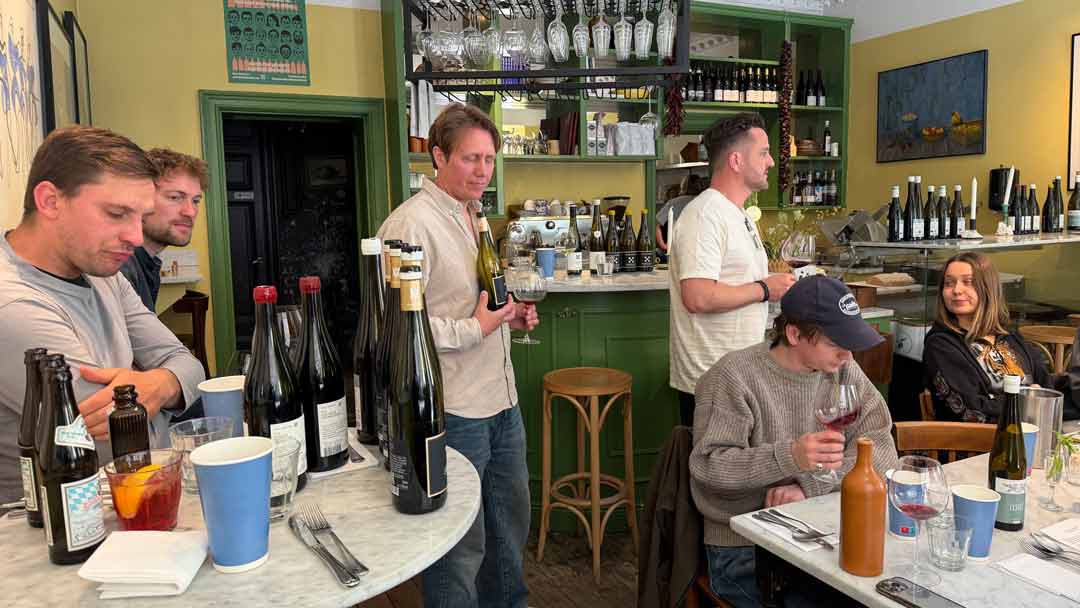
Jonas Seckinger, Michael Andres, Erik Florén (Löddrig häst) and Andy Rings at Teddys, Stockholm
Jonas Seckinger, Michael Andres, Erik Florén (Löddrig häst) and Andy Rings at Teddys, Stockholm, copyright G van den Brink

Elegance instead of power

What struck me most during the tasting was how far the modern German pinot noir style has moved away from the heavy, oaky and overripe of yesterday. Instead, it’s more and more about coolness, energy, precision and transparency. And thankfully, significantly less about power for the sake of power. Romana talked several times about how producers are now working with earlier harvests, less extraction, cooler fermentation and less new oak. All to achieve drinkability and terroir rather than maximum concentration.

Several of the evening’s best wines were around 12.5–13% alcohol and felt almost weightless in their structure. Not thin. Just elegant. For my part, I also notice more and more clearly that I am drawn to pinot noir from calcareous soils.

Seducer

Just like with riesling, the lime seems to give a special combination of energy, acidity and precision that I find difficult to resist. Romana described it well: “Pinot noir from limestone is seductive”.

And yes, that is probably exactly the right word. For me, pinot noir quickly loses its charm when the fruit starts to gravitate towards jammy and sweetly ripe black fruit. Then much of the nerve and transparency that made the grape so fascinating in the first place disappears.

Vineyard landscape with steep slopes along the Rhine river in Rheingau, Germany
Vineyard landscape with steep slopes along the Rhine river in Rheingau, Germany, copyright G van den Brink

A revolution in German pinot noir

What was perhaps most interesting during the “masterclass” was not really the individual wines but how clearly one could follow the development in Germany. During the post-war period, high-yielding clones with large berries and large bunches were planted. The focus was on volume rather than quality. Add hard extraction and generous use of new oak, and the result was often quite rustic wines.

Today, the situation is almost the opposite.

Producers work with better clone material, lower yields and significantly more careful vinification. Many also work organically or biodynamically, and several of the younger producers seem almost obsessed with finding more transparency in their wines.

Pioneers in Pfalz towards a German identity (?)

This type of initiative is not least noticeable in Pfalz (the Palatinate), where producers such as Rings, Andres and Seckinger are driving development very quickly right now.

And at the same time, there is a common streak among many of the best producers today. A clear focus on coolness, energy, acidity and transparency rather than maximum power and extraction. This is perhaps where the modern German pinot identity is starting to take shape.

Andy Rings in the barrel cellar, Weingut Rings, Freinsheim, Pfalz, Germany
Andy Rings in the barrel cellar, Weingut Rings, Freinsheim, Pfalz, Germany, copyright G van den Brink

Germany’s great strength is diversity

Another thing that became very clear during the presentation is that there is not really a single uniform style of German pinot noir. Burgundy is basically limestone. Germany is much more complex.

Here you find lime, granite, slate, loess, volcanic soil and sandstone. And the differences between the regions are great. The variations between, for example, Ahr, Baden and Palatinate are often significantly greater than between many villages in Burgundy.

The slate soils in the Ahr often gave darker and more spicy expressions, while the limestone soils in the Pfalz-Palatinate and Rheinhessen gave more floral elegance and silkier structure. Baden could simultaneously offer both cool minerality and significantly stronger expression from Kaiserstuhl.

The winery at Weingut Rings, Freinsheim, Pfalz, Germany
The winery at Weingut Rings, Freinsheim, Pfalz, Germany, copyright G van den Brink

This also means that German pinot noir never becomes monotonous.

On the contrary, it feels like the country is still defining its own identity.

That eight of the evening’s fifteen wines came from Erik Florén’s Löddrig Häst was hardly a coincidence. Few other Swedish importers seem to have as good a sense of where modern German pinot noir is headed right now. Producers such as Rings, Andres, Seckinger, and several of the evening’s most interesting wines were completely in line with the style currently driving developments in Germany: cooler fruit, less extraction, lower alcohol, and a significantly greater focus on terroir and drinkability.

Jonas Seckinger of Weingut Seckinger, Niederkirchen bei Deidesheim, Pfalz, Germany
Jonas Seckinger of Weingut Seckinger, Niederkirchen bei Deidesheim, Pfalz, Germany, copyright G v d Brink

Flight 1, best value pinot noir

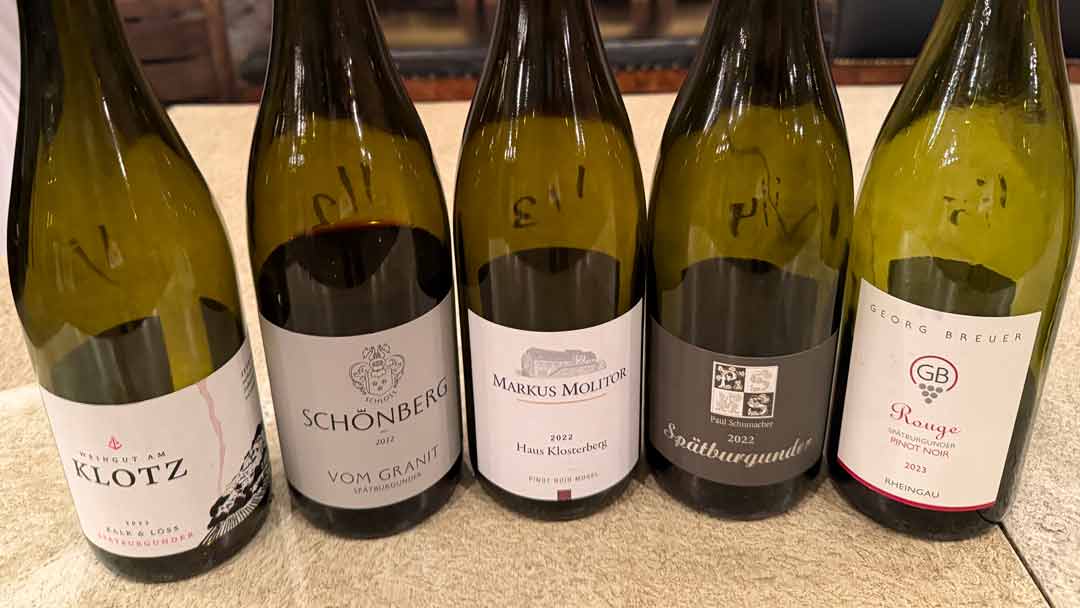
2023 Am Klotz Kalk & Löss, Weingut am Klotz, Baden

~27 euro (prices are approximate estimates based on prices in Sweden)

Perhaps the best-value wine of the evening. Lime and loess gave exactly what I’m looking for in pinot noir: cool cherry fruit, energy and a slightly chalky grip in the finish.

2022 Vom Granit, Schloss Schönberg, Hessische Bergstrasse

~26 eur

More spicy and salty mineral with the granite in a clear leading role. Slightly more mature and broader in style but still well balanced.

A series of German pinot noir, Klotz, Schonberg, M Molitor, Schumacher, Breuer
A series of German pinot noir, Klotz, Schonberg, M Molitor, Schumacher, Breuer, copyright G van den Brink

Flight 2, the new generation also loves pinot

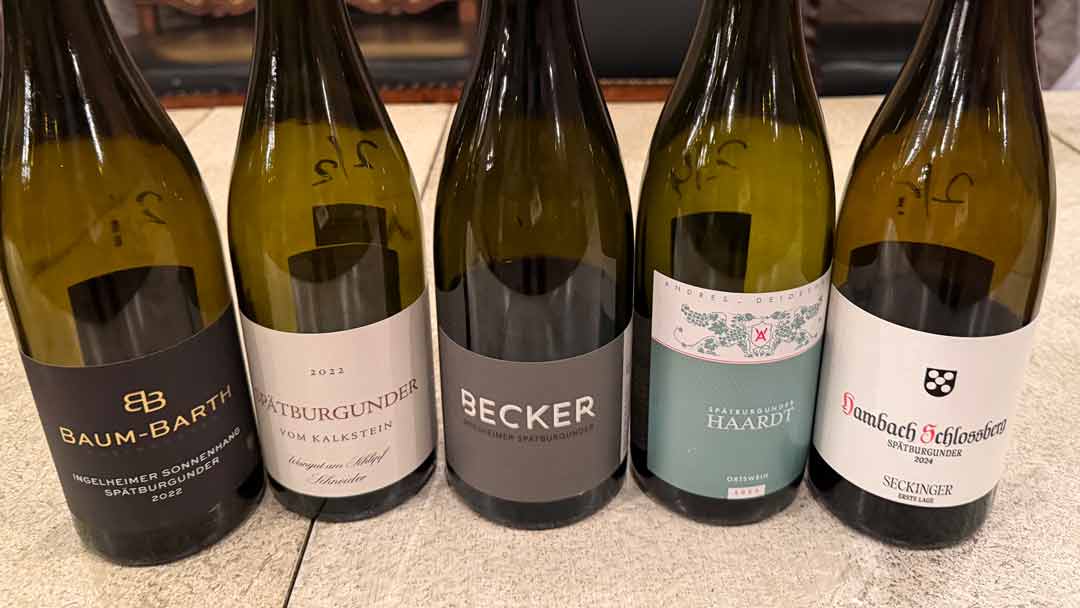
2023 Haardt, Weingut Andres, Pfalz

~24 eur

Perhaps the most typical example of the new German pinot style of the evening. Lime soil, hints of whole bunches, cool red fruit and very nice energy.

2024 Hambach Schlossberg Erste Lage, Seckinger, Pfalz

~31 eur

More reductive and significantly tighter in expression. Slightly smoky, with clear structure and low-key fruit.

A series of German pinot noir, Baum-Barth, Klotz, Becker, Haardt, Seckinger
A series of German pinot noir, Baum-Barth, Klotz, Becker, Haardt, Seckinger, copyright G van den Brink

Flight 3, classic pinot from Germany

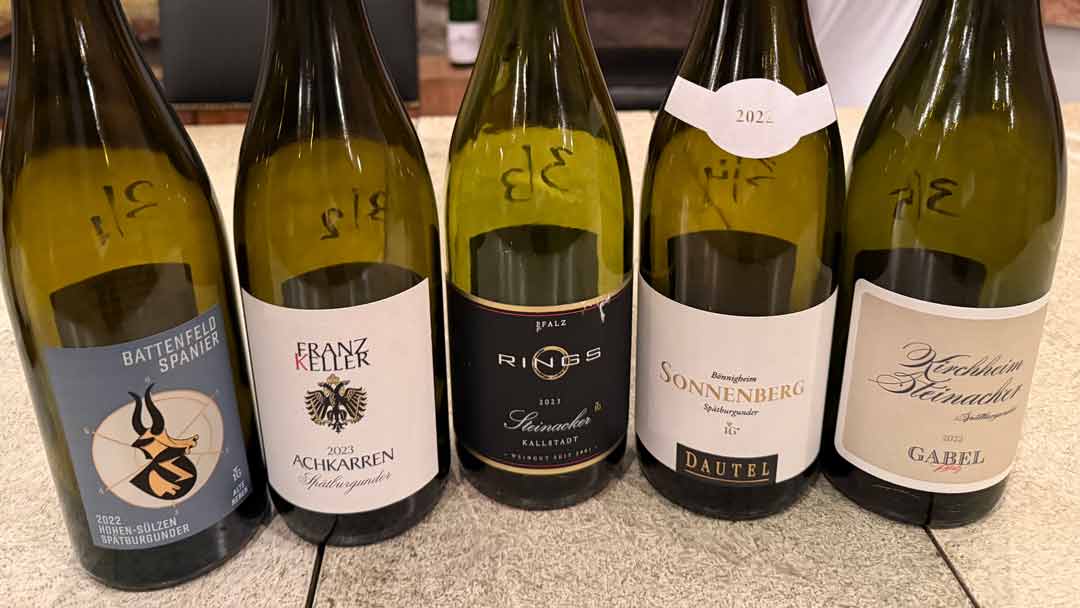
2023 Kallstadt Steinacker Erste Lage, Weingut Rings, Pfalz

~68 eur

“Best in show” of the evening.

And yes, it also costs significantly more than the other wines.

But here I also found everything I look for in a really good pinot noir. Limestone soil, coolness, precision and depth without the wine ever becoming heavy or oak-dominated.

2023 Achkarren, Franz Keller, Baden

~41 eur

Franz Keller once again shows why Kaiserstuhl is one of Germany’s most interesting areas for pinot noir. Volcanic soil and loess gave more power and depth than many other wines during the evening, but without losing precision.

The winery at Weingut Franz Keller, Baden, Germany
The winery at Weingut Franz Keller, Oberbergen, Baden, Germany, copyright G v d Brink
A series of German pinot noir, Hohen-Sulzen, Keller, Rings, Dautel, Gabel
A series of German pinot noir, Hohen-Sulzen, Keller, Rings, Dautel, Gabel, copyright G van den Brink

The next big German success?

After the enormous success of riesling, it almost feels logical that pinot noir is next in line.

The conditions are there: cool climate, enormous terroir variation, better clone material, significantly better technology in the cellar and prices that are still far below Burgundy.

And perhaps most importantly: the producers seem to have finally gained the confidence to make German pinot noir on their own terms. Perhaps that is also where the biggest challenge still lies. When I had a friend proofread the article and asked if he would like to try German pinot, I got the comment: “No, German white wines are drunk to get drunk and the reds are undrinkable. That is old news.”

Brutal? Absolutely. But also quite telling.

Well, Germany is still fighting a legacy of Liebfraumilch, Moselblümchen and rather questionable red wines from the 80s and 90s. The problem is that reality has changed much faster than prejudices. And maybe that’s why modern German Spätburgunder feels so exciting right now. Many still haven’t understood how good the wines actually have become. But that thing about the name… Can’t they just decide to call it pinot noir?

Dare to defy your prejudices, choose a German pinot next time! If you’re in Stockholm, there are some good places to try it: E&G, Teddys and Portal Restaurang.

More reading on BKWine Magazine:

Chose your language. Read the article in:

Author:

Author:

Share this post:

Leave a Reply

Your email address will not be published. Required fields are marked *

  Subscribe to comments:

Notify me of followup comments via e-mail. You can also subscribe without commenting.

SUBSCRIBE TO OUR NEWSLETTER!

25,000 subscribers get wine news every month. You too?