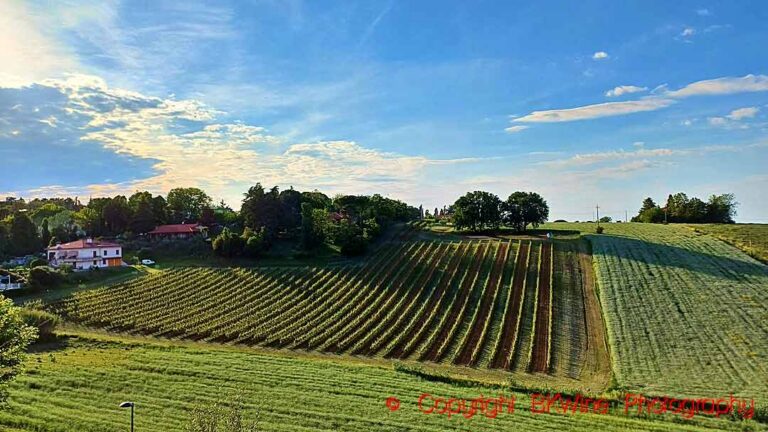
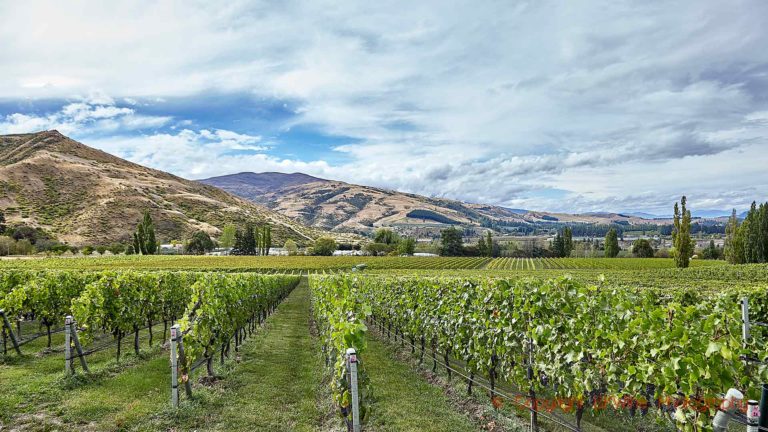
Romagna, on the Adriatic sea coast in Italy, is staging a wine revolution. Moving far beyond its old reputation for easy-drinking tavern reds, they are developing a reputation for complex and original reds from the sangiovese grape, Romagna Sangiovese. Central to the revival is their development of regional denominations and identities for the wines with a system of 16 distinct subzones. The soils are diverse, a mosaic of blue clays, marine fossils, and high-altitude Apennine forests. The climate varies according to location and altitude. Both facets highlight that Romagna sangiovese is as diverse as its landscape, from the power of Predappio to the elegance of Modigliana. No less exciting is the emergence of a strong identity for the white wines made from the albana grape. Romagna is the eastern part of the region Emilia-Romagna, also famous for its gastronomy. BKWine Magazine contributor Jeanne Peixian Qiao takes us on a myth-busting journey through Romagna’s wine landscape.
1. Romagna was never simply Tuscany’s neighbour
The story of Romagna wine can begin with a river. Not the Po, but the Tiber. Its source is on Monte Fumaiolo, in the Apennines. For more than five centuries this area belonged to Tuscany. In 1923, the border was moved. As Benito Mussolini, born in Romagna, wanted the river that symbolised the grandeur of Rome to rise in his own home region.
With that political gesture, the source of the Tiber and the surrounding mountain territory were brought into Romagna. The line on the map changed. The cultural and wine identity did not follow so neatly. In Modigliana, and in parts of the Romagna Apennines, the steep sandstone slopes, the mountain coolness and the finely built structure of the wines still speak with a Tuscan accent.
Romagna’s connection to sangiovese is older and deeper than many wine drinkers realise. One of the earliest written mentions of the name sangiovese appears in a notarial document from Faenza in 1672. Sangiovese di Romagna became a DOC in 1967, alongside the early DOC years of Chianti and Brunello di Montalcino, making it the first DOC in Emilia-Romagna and one of the earliest in Italy.
2. Romagna is no longer one generic wine region
For decades, Romagna sangiovese meant something simple: flatland vineyards, large volumes, uncomplicated reds poured in seaside trattorias along the Adriatic coast. The mountains were there, but rarely part of the story.
The change began in 2011, when the first official subzones were introduced, and was later expanded in 2019 to 16 geographical indications*. It was a response to Romagna’s extreme geological and microclimatic fragmentation, recognising that Romagna could no longer be understood as a single wine landscape.
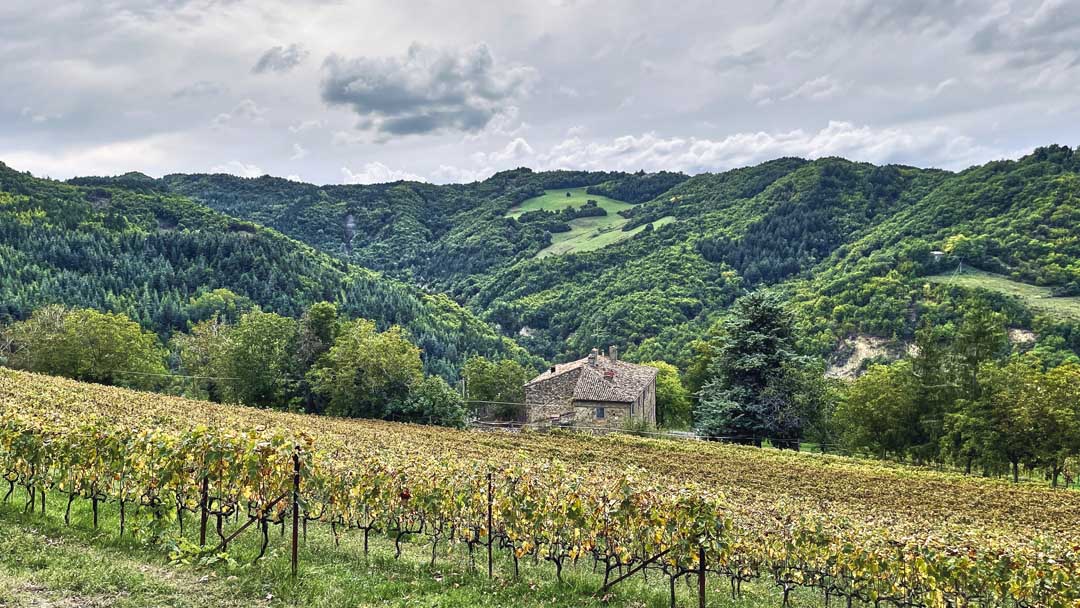
Drive south from the Via Emilia, and the shift is immediate. Clay turns into sandstone. Vineyards climb higher. Forests close in. Temperatures drop.
One image returns constantly when local producers describe the region: the Romagna Curtain, a ridge separating the brighter northern hills from the darker mountain interior. On one side are broader clay slopes and warmer exposures. On the other side are cooler forests, sandstone soils and higher altitude vineyards, the “backstage” side steeper and harder to farm, yet it produces some of the region’s most refined sangiovese.
The geology is unusually complex, even by Italian standards. Alessandro Masnaghetti, the Italian cartographer and author of the Maps of the Subzones of Romagna sangiovese, shows a mosaic in which clay, marl, sand and calcareous components alternate rapidly, sometimes within short distances. Around Bertinoro and Predappio, spungone is a fossil-rich limestone once formed beneath the sea. Around Castrocaro, blue clays and thermal waters shape another register. Higher in Modigliana, the Marnoso Arenacea formation brings alternating layers of sandstone and marl. Running through the region is also the Vena del Gesso, the gypsum ridge recently recognised by UNESCO.
3. One grape, several dialects
The 16 subzones are therefore not decorative names on a label, but a move away from generic regional identity towards one that better reflects the diversity found in the glass. Each has its own identity, although for many consumers, the growing complexity of names and styles may still take time to fully communicate. But four are enough to show the range to a first-time visitor.
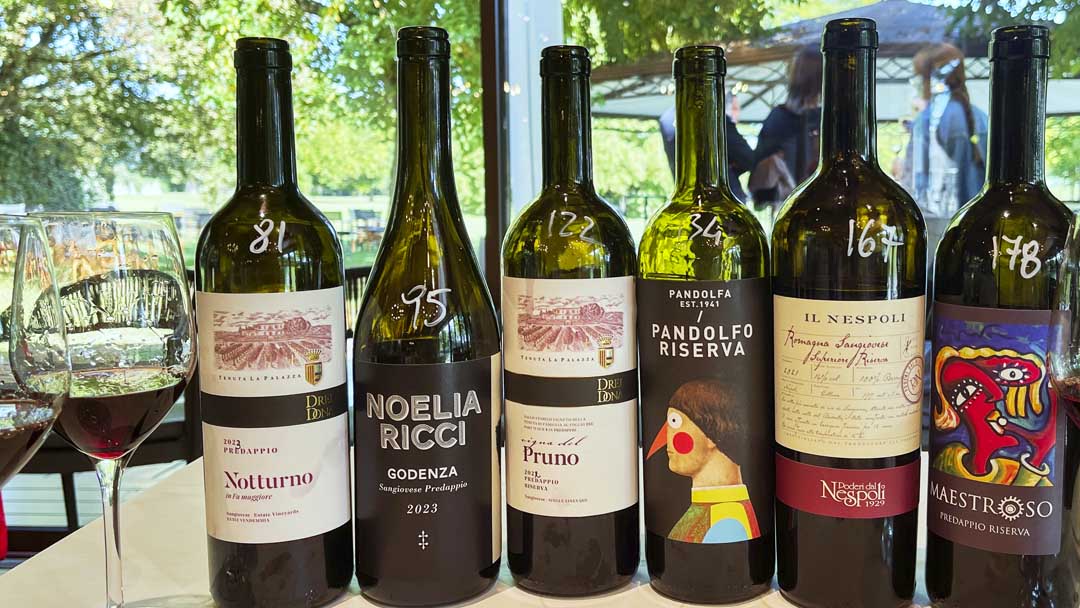
Predappio gives perhaps the most structured expression. Here, sangiovese is built on acidity and tannin, less immediate in youth and often more convincing with time. The wines can feel austere rather than generous, with a firm core and the kind of grip that explains why old bottles from cooler, classical vintages still seem alive decades later.
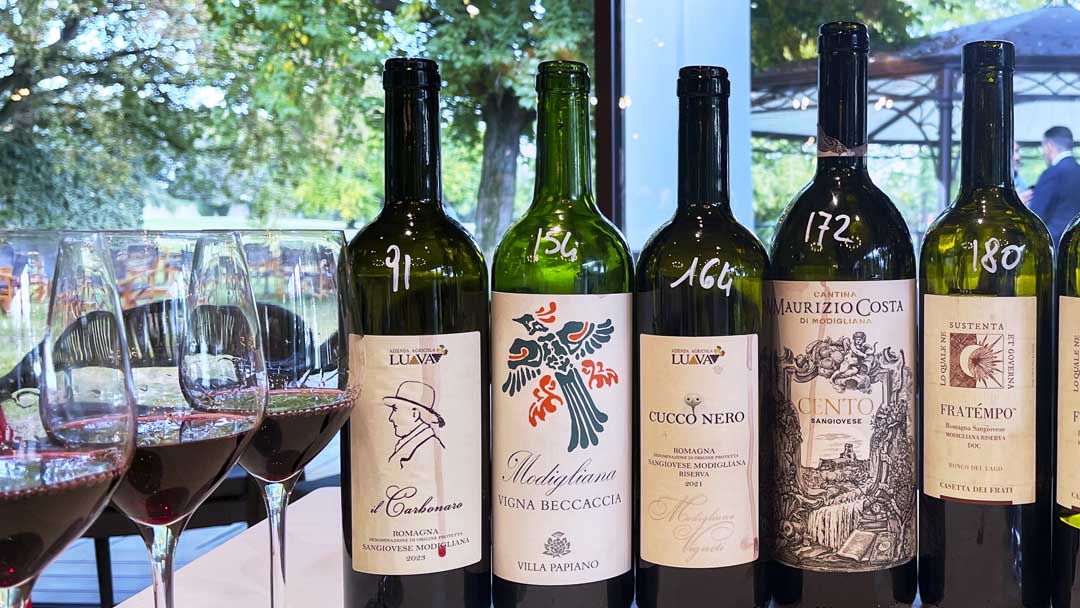
Modigliana speaks from higher ground. Sandstone, altitude, wind and forest give its sangiovese a different register: lighter in colour, sharper in line, often marked by wild herbs, salinity and a precise tension in the mouth. It is one of the clearest places to understand how Romagna can move from power to elegance without losing the character of the grape.
Castrocaro is more tactile and immediate. Its calanchi, blue clays and mineral thermal waters create a landscape that feels almost sculpted by erosion and underground movement. In the glass, the wines can combine juicy fruit and contemporary lightness with a savoury, saline note that keeps them from becoming simple.
Bertinoro brings the sea back into the story. Known as the Balcony of Romagna, it looks towards the Adriatic and sits on soils where spungone plays a central role. The wines often carry bright fruit, salt, structure and a particular ease at the finish, as if the ancient seabed and the present sea breeze were speaking together.
Romagna sangiovese is not a single voice. It is one grape speaking several dialects.
4. Romagna’s identity is shaped as much in the cellar as in the vineyard
Those dialects are not only geological. They are also human. In Romagna, the identity of a subzone is shaped not only by geology, but also by the decisions made in the vineyard and cellar.
That human factor is now one of the most interesting parts of the region. Some producers look for a clean, fruit-driven expression in stainless steel. Others use concrete for texture and calm evolution, French oak for structure, or amphora and qvevri (eg Tre Monti) for longer macerations and more tactile wines. These choices are not cosmetic. They change how sangiovese carries tannin, fruit, spice and savoury depth.
Old vines add another layer. In Modigliana, Maurizio Costa works with vines that date back more than a century. Such vineyards give tiny yields, but they can bring remarkable concentration and depth, as if the wine were drawing from a much older memory of the hillside.
Tannin management has become just as important. Whole bunch fermentation is used selectively, especially where sandy soils and warm exposures allow stems to ripen fully. The aim is not greenness, but finer structure and more aromatic complexity. Villa Papiano’s single-vineyard “Vigna Beccaccia” from Modigliana showed this clearly, with floral notes, ripe red fruit, and fine tannins carried by a lifted, energetic frame.
Ageing is another way Romagna is changing its image. The categories of superiore, riserva and superiore riserva are more than bureaucratic terms when the wine has the acidity and tannic strength to support time. Historical tastings of wines from the 1980s and 1990s showed how surprising this can be. A 1985 Fattoria Zerbina Sangiovese Superiore Riserva aged in French barriques for 12 months, still held freshness, juicy fruit and energy after four decades. It was a reminder that Romagna’s best sangiovese was never only a wine for early drinking. In the right place, and in the right hands, it can age with real dignity.
Romagna’s challenge today is perhaps no longer quality, but clarity: explaining to international drinkers why these differences matter.
5. Romagna was never only about red: come albana
Romagna may be one of Italy’s other homes of sangiovese, but it is not only red. Albana is not a side note here. It is one of the region’s most distinctive grapes and perhaps its most unexpected card at the table.
Its range is unusually wide. Albana can be dry and direct, fermented in stainless steel for freshness. It can be made as passito, where sweetness is held in place by acidity. It can be macerated on the skins, aged in amphora, or handled with a more oxidative, traditional sensibility. In the past, sweet or slightly sparkling versions were kept for special occasions, sometimes even stored under sand. Today, producers are rediscovering that old breadth with contemporary precision.
What makes albana more than a simple refreshing white is its structure. It often has low pH and marked acidity, but also a light tannic grip. The aromas can move from yellow flowers and acacia to apricot, peach and golden fruit, while the finish often carries a bitter almond note. With skin contact, the grape becomes deeper and more textured, almost red-wine-like in its ability to pair with food.
To close the story, Romagna is also a region learning to define itself under pressure. After the devastating floods of 2023, the 2024 vintage brought another test: one of the hottest and wettest seasons recorded locally since 1961, with further flooding in September. Yet sangiovese still reached both technical and phenolic maturity, and production recovered compared with the previous year. What was once described as a late ripening grape, sometimes harvested well into October, now often reaches maturity by mid-September. The wines carry the mark of a changing climate, but not a loss of identity.
To understand Romagna, one should not taste it only through a map or an article. One should drive the valleys, cross the Romagna Curtain, stand among blue clays and sea fossils, and let sangiovese, and albana, speak in their local accents.
Notes:
*16 sottozone:Serra, Brisighella, Modigliana, Marzeno, Oriolo, Castrocaro, Predappio, Meldola, Bertinoro, Cesena, Mercato Saraceno, Longiano, Imola, Coriano, San Clemente, Verucchio
The author visited Romagna as a guest of the Consorzio Vini di Romagna during the Vini ad Arte 2025 programme. All observations and assessments are the author’s own.