It was a sunny morning when I arrived at Vinos Atlante in the Valle de la Orotava, one of Tenerife’s five DO areas. I was grateful for the fine weather; the day before had been, as the locals explained, “a very typical day in northern Tenerife,” with low clouds and a light rain that didn’t feel particularly wet but in fact was.
The Orotava Valley lies on Tenerife’s north‑western coast. Having vineyards in the north makes a big difference. Tenerife is the largest of the Canary Islands, yet still not very big. Even so, the contrasts between south and north are enormous. The south is warmer and drier, protected from rain by the massive mountain range in the middle of the island, dominated by the majestic volcano Teide at 3,715 metres, Spain’s highest peak.
This means the south receives at most 200 mm of rain per year and enjoys almost constant sunshine. Northern Tenerife gets at least three times as much rain and has many cloudy days. The landscapes could not be more different: the dry, brownish terrain in the south, with impressive cactuses, and the lush, green north. Unsurprisingly, there are more tourists in the south than in the north.
But weather patterns are now unpredictable. “It has been dry, with 350–400 mm of rain per year over the last 5–6 years,” says Jesús González de Chávez, owner and winemaker at Atlante. “But 2026 has been very rainy so far, with 850 mm. That’s how it used to be, but now the vines are no longer used to it.”
A bit of history
Atlante is a family estate with a long history. As early as 1518, the González de Chávez family arrived on Tenerife from the town of Chaves in Portugal. He married an indigenous and together they grew sugarcane and planted vineyards. Sugarcane is no longer grown on the island, but today Jesús cultivates, besides grapes, avocados and oranges, all organically.
In the 1500s to 1700s, he explains, the island was covered with vineyards. Exports were important, partly thanks to the island’s strategic location. The sweet wine from the Canary Islands, made from malvasia, was famous, not least in England, where Shakespeare mentions it in several plays.
In the late 1700s exports declined, vineyards disappeared, and many people emigrated to South America. Those who stayed grew fruit and vegetables and made small volumes of wine, but of simpler quality, mostly for the family. The now‑famous bananas arrived from Brazil in the 1800s and are today the Canary Islands’ most important agricultural product. Many banana plantations are in fact located in the Orotava Valley.
The vineyard area is smaller today and the wines are, of course, completely different from before. For one thing, they are dry, and producers focus on high quality, something anyone lucky enough to taste them directly will notice.
In the vineyard
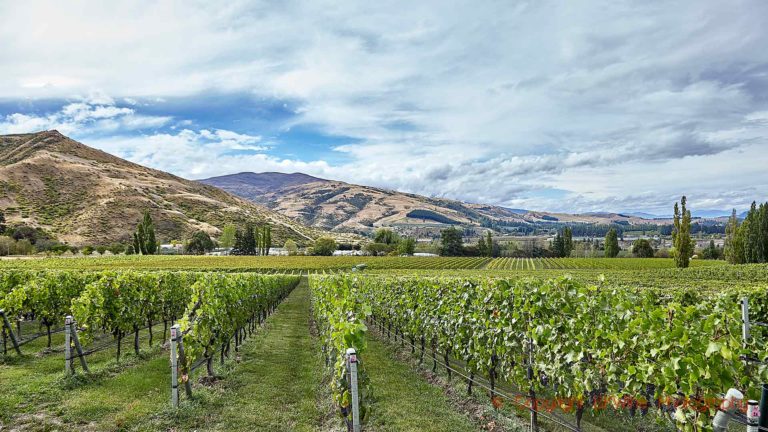
Jesús shows me his historic vineyard, La Quinta. The view over the sea is spectacular. Here are his oldest vines and the braided cordón trenzado. This is specific to Tenerife: an old, traditional training system invented by the Portuguese 300 years ago. The method creates extremely long arms, sometimes 10 metres or more. Iron forks support the long braid. The shoots are braided so that the fruiting cane of the current year rests on top of the previous year’s. Planting density is naturally low. Jesús has only 400 vines per hectare.
Trenzado is a way to protect vines from the sometimes very strong winds that blow most of the year. The method is also said to be adapted to volcanic slopes and to high‑yielding local grape varieties. “Malvasia,” Jesús says, “which used to be widely planted, needs long pruning, maybe 18 buds.”
The vines here are old — some 150, perhaps 200 years. “In a good year I get 4,000 kg/ha. Last year (2025) I got only one ton. You can get more if you have water. You can get 8 tons and still have quality.”
Jesús usually does not irrigate his vines, but he can access water if needed. Tenerife has so‑called water mines (galerías de agua). Water is taken from inside the mountains and transported through a network of pipelines to where it is needed.
The grapes
The two most common grape varieties on Tenerife are listán negro and listán blanco. But many more are grown: negramoll, albillo criollo, vijariego, marmajuelo, malvasía aromática, verdello, gual, and several others.
Listán blanco is another name for palomino in the sherry region. Negramoll is the same grape as tinta negra mole on Madeira. Jesús has recently planted sumoll, an old red Catalan variety said to tolerate drought very well. Sumoll here is not exactly the same as in Catalonia, he points out.
Jesús makes two‑thirds red wine, and listán negro is his most planted variety. “Listán negro is different here, in this old vineyard; it has a unique expression after 200 years.”
Phylloxera‑free — for now
Tenerife and the other Canary Islands have never been hit by phylloxera. But the danger exists. Tenerife had a mini‑phylloxera outbreak in 2025. The affected vineyard was abandoned, Jesús explains, so the vines were probably weak, but a non‑abandoned vineyard is also said to have been affected. It did not spread, fortunately. If phylloxera were to strike on a larger scale, it would be a huge loss, with all these very old vines. There is a lot of sand in the soil here, and the wine louse does not like sand. But as Jesús says: “Here we have 50/50 sand and clay, and that is not enough to stop phylloxera from developing.”
Atlante is founded
Jesús previously worked in banking. He later moved back to Tenerife and enrolled in the newly introduced viticulture programme at the local university. In 2014 he created the Atlante brand and left the village cooperative, which his father, like many other growers, had joined in the 1990s. The cooperative actually closed recently, which “is not good news,” according to Jesús.
In the cellar
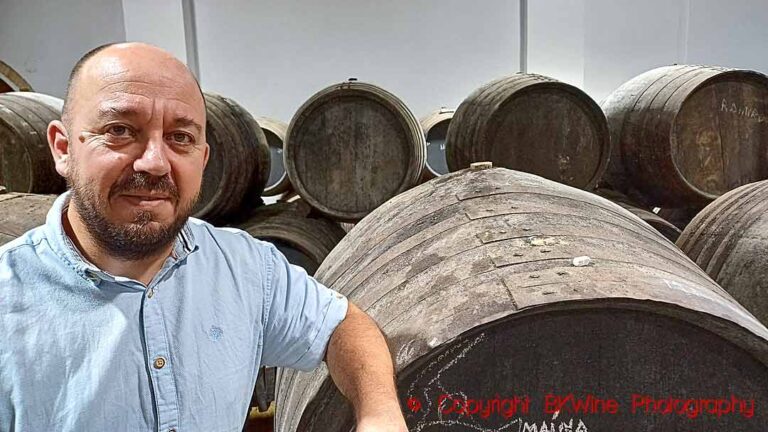
In the old cellar, tobacco leaves were dried 80 years ago, but it was later converted into a winery with Portuguese lagars, which Jesús still uses for foot‑treading some wines. “The larger surface area in a lagar gives much more skin contact.” He does spontaneous fermentation in the lagar for 4–10 days at temperatures up to 34 °C. Then a light punching down of the cap to avoid volatile acidity, and the wine finishes fermentation in stainless steel without skins.
The whites ferment at 17 °C, not too cold: “I don’t want fruity aromas and I like a bit of oxidation at the beginning.” He calls his winemaking “low intervention.” The secret is taking time during production, he says. Another hallmark is the low pH of his wines, 2.9–3.1. “The wines protect themselves; they don’t need sulphur.” Only a small part of the wines see oak, and if they do, it is usually old 600‑litre barrels.
The Wines
Atlante 2021 Listán Blanco de Canarias / Albillo Criolla, DO Valle de la Orotava, Tenerife
A blend of 50% albillo criolla and 50% listán blanco. Here, Jesús says, albillo criolla gives the wine fine fruit and lively acidity. He continues: “The style is intentionally non‑reductive, which gives a profile that highlights the fruit and aromas and tends toward honey with ageing.” I already find hints of honey together with citrus, lovely freshness, a touch of salinity and a dry finish (residual sugar only 0.8 g/l). Twelve months on the lees give the wine body. From a high‑altitude vineyard at 650 metres.
Atlante La Musa 2021 Albillo Criolla, DO Valle de la Orotava, Tenerife
La Musa shows what albillo criolla can achieve with patience. This grape needs time, Jesús tells me. “With patience during production, you get a reward.” The wine has intense flavours, a silky structure and a generous mouthfeel. Long, persistent and expressive finish.
Atlante Vidueño 2020 Field Blend, DO Valle de la Orotava, Tenerife
Vidueño is a traditional field blend where several local varieties ferment together: listán nero, vijariega, castellana and negramoll. He picks the grapes slightly underripe and uses 100% whole clusters (“the stems take away a bit of the acidity”). Skin contact is short, 3–4 days. The wine is light, herbal and slightly spicy, with fine texture. “Light but not simple,” as Jesús says.
Atlante Listán Negro, DO Valle de la Orotava, Tenerife
From the historic La Quinta, the vineyard with the oldest vines and the unique braided training system. Here we have a listán negro with darker fruit, freshness and more depth. Longer skin contact in lagar, 30% whole clusters, and a style that remains light but with clear character.
Atlante El Loco 2020 Listán Negro, DO Valle de la Orotava, Tenerife
An experiment that became a success. Jesús picked very ripe listán nero and aged the wine for three years in barrel, resulting in extraordinary acidity, a touch of volatile acidity that adds complexity, and rich fruit. From a lower, warmer vineyard. Not yet released.
Atlante Viejo Listán Blanco & Albillo Criolla, Tenerife
This is a very special wine. It is a solera started in 2013 in a chestnut barrel. He adds 15% new wine each year. Over the years the wine’s character and properties change. Now the total acidity is an incredible 13 g/l, the sugar is 30 g/l and the alcohol is 16% (up from 13%). Honey notes, dried figs, intense, sweet but very fresh.
“This may have been the type of wine originally made here on Tenerife,” Jesús muses. Lucky them.