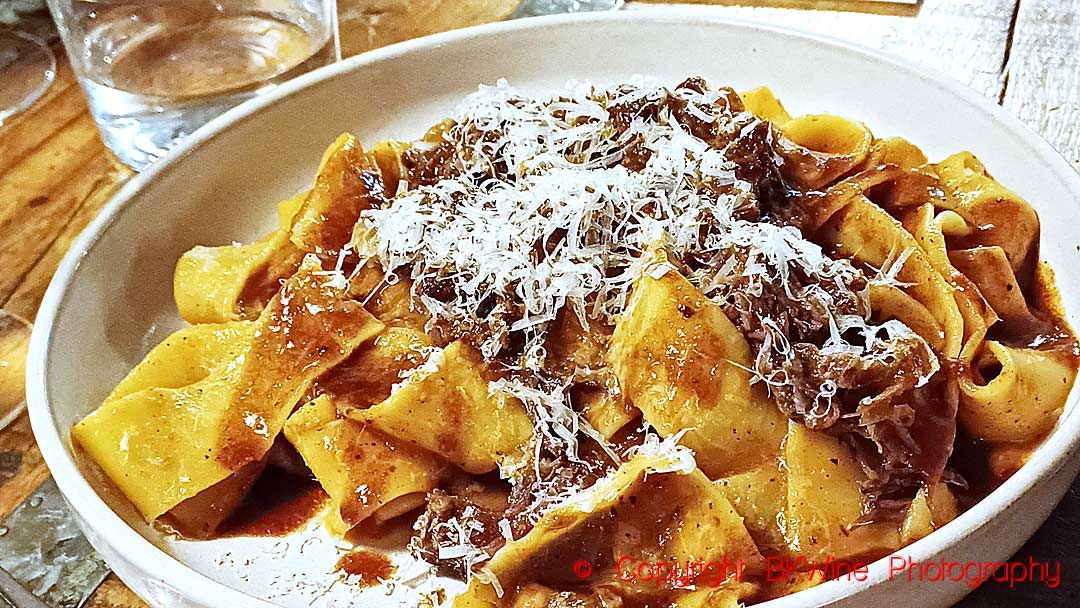
Francesco Lollobrigida, Italy’s Minister of Agriculture, was shocked when he recently found ready-made spaghetti carbonara with the wrong ingredients in the shop at the European Parliament. Carbonara is made with four ingredients (plus spaghetti, of course), and here they had managed to get two of them wrong. Worst of all was the use of cream instead of egg yolk — a cardinal sin, according to Lollobrigida. (Who, incidentally, is a distant relative of the legendary actress.)
On the other hand, who decides how a spaghetti carbonara should be made?
Fortunately, there are no legal rules for how to prepare a classic dish. If there were, we probably wouldn’t see nearly as many new cookbooks being published as we see today. As it is, a chef can put their own spin on a classic dish and still call it by its name, say, bœuf bourguignon. The Swedish speciality – and now world-famous – gravlax (*) can be made in the most peculiar ways. In France, it is sometimes not even made with salmon but with beef. The French then call it gravlax de bœuf, which is, of course, slightly ridiculous, as lax is the Swedish name for salmon.
(*) Gravlax is salmon (lax is salmon in Swedish) marinated in salt, sugar and dill, so, by definition, it is made from salmon. “Grav-” refers to that the salmon was put in a pit dug in the ground, gräva being Swedish for to dig, also the origin of the English “grave”. So, if you wish, gravlax is “salmon in a grave”…
–
Calling all wine lovers:
Do you know someone who might be interested in a wine tour?
Please tell them about BKWine Wine Tours! We do wine tours like no other.
A leading wine tour operator since more than 20 years.
Thank you in advance for your help and support!
(If you have Swedish friends, please know that we have a separate,
more extensive travel program in Swedish: BKWine Vinresor.)
–
One is entirely free to modernise gastronomic treasures. Cuisine revisitée, as they sometimes say in French (reinterpreted cuisine). What arrives on the plate will look nothing like the classic dish one thought one had ordered.
In the world of wine, things are not quite as simple — to start with, there are more rules – even though one might argue that reinterpretation is needed there more than in gastronomy. Why not a bordeaux revisité? Several châteaux are actually attracting new consumers with a different style — light, fruity, without oak—a good complement to classic Bordeaux.
The classics — whether Napa Cabernet, Rioja, Bordeaux or Châteauneuf‑du‑Pape — suit some consumers but not all. Reinterpreting wine can be done within an appellation’s existing rules by simply ignoring what is customary. There is, for example, no rule that says a Bordeaux must be aged in oak, nor what the grape blend must be (as long as the grapes are permitted). For a Rioja, one year in barrel is enough according to the regulation, and the winemaker may choose the size and age of the barrel. There is no excuse today not to adapt to consumers’ tastes.
In practice, wines are being “revisited” continuously. Today’s Bordeaux bears only a faint resemblance to that of the 1960s. Tradition, technology, and consumer preferences change gradually — slowly — and one may not even notice it happening. (A consequence of this is that “typicity” is a poor way to judge the quality of a wine leading to stagnation rather than quality (although some people unfortunately claim that typicity is an important factor in quality). Read more about that here: Quality is subjective, not objective (and so is “typicity”). Who has the right to decide how a wine should taste?)
Surely some consumers enjoy carbonara with cream. Why shouldn’t they be allowed to have it? In addition, carbonara is a dish that was first mentioned only after World War II, so the tradition is not very long.
But just a week after Francesco Lollobrigida’s outburst, Italian gastronomy had its revenge, of sorts. UNESCO approved Italy’s application to have its gastronomy recognised as intangible cultural heritage. So now you’d better call your pasta by its proper name, or you might be in trouble. On the other hand, pizza (the Neapolitan one) is already a UNESCO cultural heritage, and that hasn’t exactly stopped creative pizzaiolos from making their own interpretations.
French cuisine has no UNESCO status, but “the French gastronomic meal” does. A complete four-course dinner, says UNESCO, strengthens family bonds and promotes social connections; therefore, it is essential to pass on to new generations. We can only agree. After a long and intense workday (and we have many of those), a good and leisurely dinner is the best way to unwind, relax, and be with the family.
Eating many long, delicious dinners with equally good wines is surely a New Year’s resolution better than most — and easier and more pleasant to keep than many others.
With that, we wish you a very Happy New Year.
Travel
Now it’s time to plan your trip for next year.
We do not have any places left on the winter wine tours, but soon we will publish the entire autumn travel program for 2026, as well as the winter of 2027. You will get a sneak peek below.
More info on our wine tours here. “World’s Top Wine Tours“. Tours with the people who know wine and who have an unrivalled experience of wine and tours.
Travel in wine regions with someone you trust.
Enjoy the Brief!
Britt & Per
Wine editors to the national encyclopedia, Forbes.com contributors, award-winning wine book authors, wine tour advisors to the UN and national wine organisations, wine judges … and, above all, passionate wine travellers.
If you appreciate what we do, you can help us: Tell your friends about the Brief or send it to them.
Like us and follow us on social media:
BKWine Magazine on Facebook | Wine Tours on Facebook
Twitter | Instagram | Linkedin | YouTube