For an industry that celebrates tradition and old myths, the wine industry is surprisingly obsessed with news, from the Swedish wine monopoly’s new releases several times a month, manically followed by wine enthusiasts, to visitors’ delight over amphorae, concrete eggs (well, not so new anymore) and anything else that looks a bit spectacular. People expect traditions and a long history, but at the same time, new and “different”.
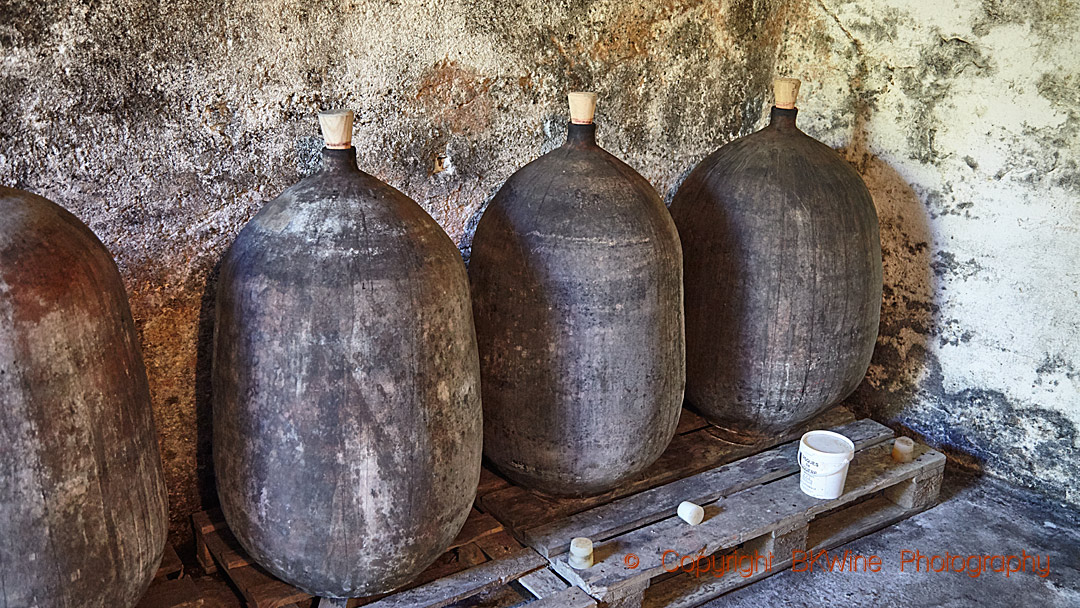
As mentioned, amphorae are not particularly new anymore, and also several thousand years old if you like. Only your imagination sets a limit to the materials and shapes you can use for fermentation and ageing vessels. We have seen gold-plated barrels, marble, glass, granite sarcophagi, and, of course, stoneware with different firing temperatures.
–
Calling all wine lovers:
Do you know someone who might be interested in a wine tour?
Please tell them about BKWine Wine Tours! We do wine tours like no other.
A leading wine tour operator since more than 20 years.
Thank you in advance for your help and support!
(If you have Swedish friends, please know that we have a separate,
more extensive travel program in Swedish: BKWine Vinresor.)
–
But don’t get me wrong, such a thing certainly makes a difference. For example, read about the tasting we participated in that compared wine aged in nine different containers: One wine, aged in nine different tanks, a tasting by Domaine Gayda | Per on Forbes. Big differences. Or the syrah wine from Italy fermented and aged in six different ways at the Nordic Sea Winery (Oenoforos) made in Simrishamn: Six secret wines show the importance of the winemaker. (The winemaker’s choice, in this and everything else, is at least as important as, for example, terroir and climate.)
It is natural for a wine writer to want to write about something new, a winemaker in Champagne told us recently. But, he continued, news does not necessarily have any practical significance (see, for example, above, about gold-plated, although that particular winemaker can no doubt find a difference). In Champagne, it is easy to write about the “brut nature” champagnes, even though it is a tiny part of all champagne that is brut nature. It is exciting and different to write about. You can easily get the wrong impression from writings, he believed. What people want is still ordinary brut, with a little more sugar in it.
And the others, those who are not amazed and fascinated by the news, are they boring, backwards-looking ones?
In fact, can you at all say today that “we do what we have always done”? Can you make wine today, without any fuss, dazzle and the newest gadgets?
The truth is that they probably cannot because new things find their way into the cellar all the time. The wine world is constantly changing. Everyone has something new in the cellar or in the vineyard, even if it’s just a new type of pump or a better rootstock.
And that is probably a good thing. “The wine of the olden days”, the kind that is often praised by those who say wine was better and more natural before the industrial revolution destroyed genuine and authentic wine, is probably not the kind of wine we want to drink today; made with lots of sulphur, sugar, spices to hide the vinegar taste, arsenic and nicotine sprayed in the vineyard and so on. The kind of thing that was done “in the past”. Well, perhaps not always but it certainly happened…
Some news/changes have great practical importance.
In 1971, Émile Peynaud (often called the father of modern oenology) wrote the classic “Connaissance et travail du vin” (available in English translation, “Knowing and Making Wine). It remains a very relevant book, and a new edition was published just over a year ago.
1971 is not that long ago, not ages away. However, consider that back then, in 1971, there were no harvesting machines (they began to appear gradually from 1973), no practical way to control the temperature during fermentation, and no cultured yeast. They didn’t know if malolactic fermentation was an advantage or a disease. The analytical laboratories were at nearly the same level as they were a hundred years earlier in Pasteur’s time. They didn’t have tangential filtration, imagine that. All of this we take for granted today.
That makes one realise that a lot has happened and that a lot is happening all the time. In addition, all these small and large changes mean that today we can drink wines that are much less affected by defects (almost gone today) and that are much tastier and generally more affordable than “before”. Good wine to the masses!
So, if someone says “as we have always done”, you should not believe them. Thank goodness.
Travel
The travel season is almost but not quite over so it is a bit of a challenge to have time to write and edit the newsletter this month.
But now it’s time to plan your trip for next year.
We do not have any places left on the winter wine tours, but soon we will publish the entire autumn travel program for 2026, as well as the winter of 2027. You will get a sneak peek below.
More info on our wine tours here. “World’s Top Wine Tours“. Tours with the people who know wine and who have an unrivalled experience of wine and tours.
Travel in wine regions with someone you trust.
Enjoy the Brief!
Britt & Per
Wine editors to the national encyclopedia, Forbes.com contributors, award-winning wine book authors, wine tour advisors to the UN and national wine organisations, wine judges … and, above all, passionate wine travellers.
If you appreciate what we do, you can help us: Tell your friends about the Brief or send it to them.
Like us and follow us on social media:
BKWine Magazine on Facebook | Wine Tours on Facebook
Twitter | Instagram | Linkedin | YouTube