—
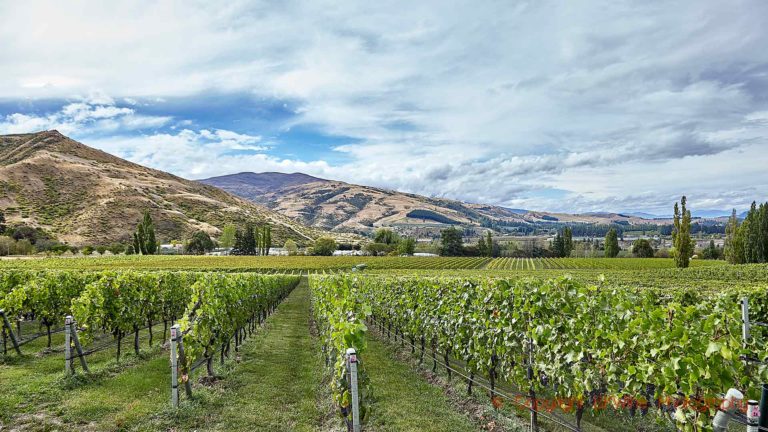
Volcanic wines, myth or truth?
—
 “Volcanic origin is not a marketing concept,” says Jean-Baptiste Deroche, referring to the fact that wines can now be certified “volcanic origin” by the Vinora association of which he is chairman.
Perhaps not the origin itself. However, for a few years now, this branding has been undeniably transformed into a marketing concept. And it is a brilliant one.
Vinora has identified around 30 wine regions where producers can choose to Vinora-certify their wines. They are very different on from the other: Mosel, Mallorca, Canary Islands, Willamette Valley (Oregon), Limarí (Chile), Styria (Steiermark, Austria), Mount Ararat (Armenia), Alsace Grand Cru Rangen, Savennières (Loire), parts of Beaujolais, Santorini (Greece), Tokaj, Aglianico del Vulture, Soave, Etna and several others.
–
Calling all wine lovers:
Do you know someone who might be interested in a wine tour?
Please tell them about BKWine Wine Tours! We do wine tours like no other.
A leading wine tour operator since more than 20 years.
Thank you in advance for your help and support!
(If you have Swedish friends, please know that we have a separate,
more extensive travel program in Swedish: BKWine Vinresor.)
–
What they have in common is that they have a bedrock that is of volcanic origin. This does not mean that the wines have a similar character. They come from all corners of the world, with different climates, different soils, different grape varieties, different everything. The volcanoes beneath their feet may have been dormant for millions of years or may still be active, like Etna, with recurring small (and sometimes larger) eruptions. Auvergne in the French Massif Central, where Vinora is based, has 80 long-extinct volcanoes.
Why a wine tastes a certain way is incredibly complex. Like limestone or schist soils, soils of volcanic origin can be gravelly, rocky, or clayey, with different capacities to absorb mineral nutrients, different water-holding properties, and good or poor drainage.
But they have one common denominator – the volcano. Is there, therefore, also a common denominator in the character of the wines?
No.
All winegrowers have stories to tell about their soil. But slate, limestone, loess… they don’t quite have the same resonance as volcanic wine, do they?
Say volcanic wine, and people see in front of them, well, what do they really see? Fire? Smoke? Sputtering lava? Intense heat? But that volcanic wines are fiery and warm is not at all the message they want to emphasise. Somewhat paradoxically, Vinora says that volcanic wines give “salty, pronounced freshness and minerality”, which feels a bit like the opposite of the image of a volcano. Admittedly, they also say “smoky notes,” but that can’t really be taken seriously, can it?
To be certified, your vineyard must undergo a strict scientific analysis that proves that the soil where the grapes are grown is of recognised volcanic origin, such as basalt, trachyte, andesite, or gabbro.
Through the certification, says Vinora, “they help to give the term volcanic wine an economic value”. This is particularly important nowadays, as consumers increasingly want a story behind the wine. It is somewhat akin to the label “old vines” in South Africa, or the media-hyped “old vine register” that recently emerged. A way to potentially charge a little more for your wine. What is that, if not marketing?
It is easy to be fascinated by volcanoes. But when it comes to freshness, saltiness and minerality, many soil types want to be part of the game. Think of flint-stone in Sancerre or chalk in Champagne. Who has not felt saltiness in a Chablis or a Vinho Verde? (If you do feel saltiness in a wine. Not everyone does.) Faugères in Languedoc highlights its schist as an exceptional rock, quite unusual too, and with a “unique minerality”. There is a lot of freshness, minerality and saltiness flying around in the tasting rooms these days.
Do buy volcanic wines, but don’t pay too much attention to the marketing claims that they have a “unique character”.
Who dares to do a simple test? Blind-taste ten different wines of similar quality, from ten different wine regions, five from volcanic regions, five from non-volcanic regions. How likely do you think it is that one could correctly identify the five wines that are “volcanic”?
So, the answer to the question in the title will have to be both myth and truth. And undoubtedly marketing .
On to this month’s Brief.
We would especially like to draw your attention to the article about our book “The Wine for the Future”. In June we were at the Gourmand World Cookbook Awards competition and our book won the prize as the world’s best book on sustainability in wine and other beverages, as well as third place in the world’s best wine book all categories, best of the best. Read more about this in the article below.
Also take an extra look at the article about Mount Cook and the excursion on the glacier lake Lake Tasman in New Zealand. It is an in-depth text with lots of pictures and some videos about the absolutely fascinating boat excursion we do on our wine tour to New Zealand. See more in the article below.
Travel
Last-minute Bordeaux: We have two places left on the Bordeaux tour at the end of September. Book urgently if you want to join us. We have some magnificent visits lined up for you. Take a look at the details further down in the travel section of the Brief.
Winter Wine Tours
All three winter wine tours will be back in 2026.
- Chile-Argentina, January 12-25, 2026
- South Africa, February 15-25, 2026
- New Zealand, March 10-25, 2026
Book now! Only a limited number of places left.
See how it’s been this year in these three tour Facebook groups:
- Chile and Argentinas wine tour on Facebook
- South Africa wine tour on Facebook
- New Zealand wine tour on Facebook
Click Join and then choose how many notifications you want – everything, the most important, nothing.
More info on our wine tours here. “World’s Top Wine Tours“. Tours with the people who know wine and who have an unrivalled experience of wine and tours.
Travel in wine regions with someone you trust.
Enjoy the Brief!
Britt & Per
Wine editors to the national encyclopaedia, Forbes.com contributors, award-winning wine book authors, wine tour advisors to the UN and national wine organisations, wine judges … and, above all, passionate wine travellers.


If you appreciate what we do, you can help us:
Tell your friends about the Brief or send it to them.
Like us and follow us on social media:
BKWine Magazine on Facebook | Wine Tours on Facebook
—
What’s on at BKWine Tours
BKWine is also one of the world’s leading wine tour operators. Here’s what we currently have on our scheduled wine tour program:
- Burgundy and the Rhone Valley, 17-25 September 2025
- Bordeaux, wine, gastronomy, chateaux, 28 September – 4 October 2025
–
- Chile-Argentina, 12-25 January 2026
- South Africa, 15-25 February 2026
- New Zealand, 10-25 March 2026
We also make custom designed wine tours.
And we have an extensive travel program in Swedish: BKWine Vinresor.
We’re different than most other wine tour operators. We are people who know wine inside out, who travel constantly in wine regions, who write award winning books about wine. Who do this out of passion.
Our wine tours are different from others.
A typical year we organise more than 30 wine tours to destinations across the world. In Europe: France, Italy, Spain, Portugal and more. World-wide: South Africa, Chile, Argentina, New Zealand. Thanks to our Scandinavian background we have a separate offer for the Scandinavian market. These are sometimes offered in English and also available as custom made tours. For example, these destinations:
—
Read our books
We have written eleven wine books. They have won awards from the Gourmand Awards, The International Organisation of Vine and Wine (OIV) and others.
Unfortunately, only one of them has been translated to English; the others are (so far) only available in Swedish. This is the one that is available in English:
Here’s the full list of our books:
- The Wonderful World of Wine
- Languedoc-Roussillon, the Wines of Southern France
- Champagne, the Wine and the Growers
—
News from the World of Wine
—
Short briefs on what’s been happening in the world of wine recently and other interesting things.
—
Phylloxera threatens the old ungrafted vines of the Canary Islands
There are a few wine regions around the world that have not been affected by phylloxera, the dreaded vine louse. This depends on various factors, such as the soil composition (for example, a high sand content) or a protected location (as in the case of Chile). The Canary Islands are one such region. However, the vine louse was recently discovered in two places on Tenerife, where, as in Lanzarote, most of the vines are planted on their own roots. Winegrowers are concerned, but at the same time, they hope that the louse will not thrive in the volcanic soil on the island. The Greek volcanic island of Santorini and the Italian Etna and also Cyprus have also managed to retain their ungrafted vines. They are all islands, and this may also have some significance. Read more: winespectator
Read our article on BKWine Magazine about the wines of the Canary Islands: Amazingly fresh wines from the warm and windy Canary Islands. Who would have thought that possible? | Britt on Forbes.
Violent fires in Languedoc, but vineyards can act as a barrier

Europe has been hit by an unusually high number of forest fires this summer. So far this year, there have been twice as many compared to the same time in 2024. In early August, violent fires started in Corbières, one of the major wine regions in Languedoc. Although there is still no clear overview of all the damage, it is evident that there is potential smoke damage to the grapes. Those that have survived. Local laboratories are collaborating with winemakers to develop solutions. The cost will be high for a production area that is already struggling with crises. The fires in the Aude department have affected more than 16,000 hectares, but some houses and homes have been spared thanks to the presence of vineyards. In many places, they have acted as effective fire barriers. Vines don’t ignite and burn as easily as forests. This is a fantastic feature, and that is why there is now concern that the area under vines is decreasing in the wake of the wine crisis.
Richard Smart, an influential viticulturist, has passed away

Richard Smart passed away recently at the age of 80. He was from Australia and one of the world’s most famous viticulturists. He had consulting assignments all over the world and taught many wine growers the importance of taking care of their foliage and adapting the size, thickness, and other factors to the climate and weather. “Canopy management” became a buzzword. He became something of a specialist in viticulture in countries with cool climates. I met Richard in Denmark in 2005 when he gave a lecture to Danish (and some Swedish) wine growers. It was 20 years ago, but the fact is that his final words to us were that “there are two things that threaten wine today, and one is global warming and the other is that wine consumption around the world is decreasing.” Not much has changed since then.
Richard thought it was cold in Denmark; it was 10 degrees C that June day in 2005 (!). Throughout the day, Richard maintained a certain scepticism about Denmark as a wine-producing country and urged all growers to focus solely on sparkling wine. The climate, Richard believed, is what is most important for wine. Next comes the grape variety, followed by the wine producer. And the soil in all of this? The importance of the soil is exaggerated, he said. “The chemical composition of the soil is not important, but the physical properties are, because they affect drainage.”
New Zealand makes the Chinese drink white wine

The Chinese have never been particularly fond of white wines. They mostly buy and drink red wine, not least because red is considered the lucky colour in China, but also because red wines have been associated with prestige. If you are going to give wine as a gift, you give a red wine. However, a lot has happened in China in recent years, and habits have also changed. Now people are starting to drink white wines. And it is all thanks to New Zealand. Imports of white wines from New Zealand have significantly increased in both volume and value, while imports of red wines have decreased from France, Australia, and Chile. One reason, they say, is that a more informal style of business meetings is developing where people want lighter, fresher wines. A sauvignon blanc from Marlborough fits the bill. The trend is particularly noticeable among younger people and in economically well-developed regions. Read more: vino-joy
Travel: Come on a wine tour to New Zealand with BKWine.
See: See pictures and videos from New Zealand 2025 in the wine tour’s Facebook group.
Outdated appellation rules make the famous Pomerol Chateau Lafleur leave the appellation
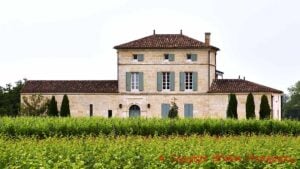
Are the rules and regulations of the French appellations keeping pace with climate change? At least Château Lafleur doesn’t think so, as from this vintage, 2025, it will leave the Pomerol appellation and sell its wines as vin de france, the lowest category, the one that was previously called table wine. The reason is said to be that the chateau believes the rules for the appellation are preventing it from meeting the challenges posed by the climate crisis. For example, they want to be able to irrigate regularly from spring onwards (currently only allowed during prolonged droughts), plant at a lower planting density (the rules require a minimum of 5,500 plants per hectare), and install permanent or temporary devices to shade the grapes. I wonder what they will call their wine in the future. A vin de france cannot be sold with a name including “chateau” or “domaine” or similar since a vin de france, according to the rules, does not have a defined and controlled origine (other than France). Read more: vitisphere
Travel: Come on a wine tour to Bordeaux with BKWine. (PS: We’ve written a prize-winning book on Bordeaux.)
Is the foil on the champagne bottle really necessary?
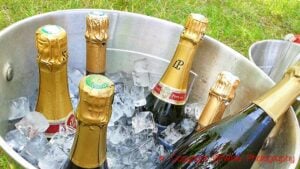
The Comité Champagne has just decided to make it optional for producers to have the familiar foil around the neck of the bottle. This foil has long been a hallmark of champagne bottle identity, and it has been mandatory to include it. But then some smaller champagne producers began to question its necessity. In the name of sustainability, they want to eliminate it because they believe the foil is merely an unnecessary decoration. It wastes resources and costs money. However, most houses do not agree. They believe the foil is an integrated part of the champagne experience, signalling a prestige image. A recent study has shown that consumers indeed perceive the foil as a characteristic of champagne that influences their choice, generally leading them to prefer a bottle with foil over one without. But the lack of foil does not lead them to choose anything other than champagne. The study, according to the Comité Champagne, therefore shows that there is no significant risk, either to Champagne’s image or to the sector’s total sales, if some want to forgo the foil. So be prepared, although I imagine not many will do away with it. Read more: champagne
Travel: Come on a wine tour to Champagne with BKWine. (PS: We’ve written a prize-winning book on Champagne.)
Wine recommendations from New Zealand, with focus on smaller producers
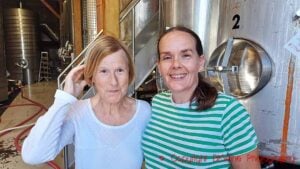
New Zealand wines available abroad is dominated by large, internationally well-known wine companies (you will probably recognise their names). But there are also smaller family-owned producers. Here are some of the ones we recommend. And it’s not just sauvignon blanc and pinot noir. Go for the producer if you can’t find this particular wine.
White New Zealand wines
- Te Whare Ra Chardonnay, 2020, Marlborough, ~30 euro
- Millton Vineyard Te Arai Chenin Blanc, 2021, Gisborne, ~30 euro
- Te Mata Estate Chardonnay, 2023, Hawke’s Bay, ~20 eur0
- Clos Henri Estate Sauvignon Blanc, 2023, Marlborough, ~20 euro
- Gardo & Morris Extra Brut Blanc de Blanc, Marlborough, ~20 euro
- Tinpot Hut Sauvignon Blanc, 2018, Marlborough, ~25 euro
- Pegasus Bay Bel Canto Dry Riesling, 2023, Waipara, ~30 euro
Red New Zealand wines
- Greystone Wines Nor’wester Pinot Noir, 2023, North Canterbury, ~20 euro
- Tinpot Hut Pinot Noir, 2017, Marlborough, ~30 euro
Perhaps this can also serve as an inspiration to organise a New Zealand wine tasting? (To explain the perhaps random-looking selection of wines, this is essentially what is available in Sweden from smaller NZ producers.)
Travel: Come on a wine tour to New Zealand with BKWine.
See: See pictures and videos from New Zealand 2025 in the wine tour’s Facebook group.
—
Features of the Month
—
Articles and features published on BKWine Magazine and on our wine travel blog and (occasionally) photography blog in the last month.
—
”The Wine for the Future”, our latest book, wins prize as “world’s best book on sustainability” and “world’s third best wine book”
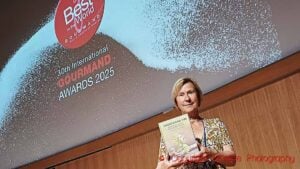
In June, we had a few wonderful days on the Portuguese Atlantic coast. But we weren’t there to swim and sunbathe, or even to taste wine. We were in Cascais because the Gourmand World Cookbook Awards having its awards ceremony for the best books in food and drink in 2024. And we won first prize for The Wine for the Future – Framtidens vin — in the “sustainability” category and third prize in the “world’s best wine book” category. The fact that Iberia then lost our luggage on the way home didn’t matter much. We were happy for our great prizes!
Read more in Per’s article on BKWine Magazine: Our book “The Wine for the Future” won the award as the world’s best book on sustainability in Gourmand International.
Mount Cook, boat excursion on glacier lake, icebergs – on the wine tour in New Zealand (text, images, videos)
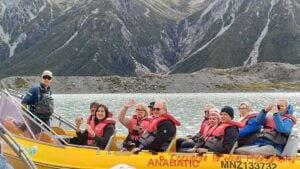
On our New Zealand tour, from north to south, we see a lot of New Zealand’s landscape. Beautiful, sometimes spectacular. Perhaps the most extraordinary is Mount Cook Aoraki, New Zealand’s highest mountain and the pride and summit of the Southern Alps. We spend a night at the Aoraki Mount Cook nature reserve and go for a boat excursion on Lake Tasman to take a close (but not too close) look at the icebergs and the Tasman Glacier. Next to it are the two extraordinary, intensely blue glacier lakes, Pukaki and Tekapo. Aoraki Mount Cook reaches a height of 3,724 metres (12,218 feet). Not long ago, it was 3,764 meters high, but then something happened in 1991…
Read more in Per’s article (with text, photos and videos) on BKWine’s Wine Tour Blog: The unforgettable spectacle of Mount Cook and the Tasman Glacier Lake.
Travel: Come on a wine tour to New Zealand with BKWine.
See: See pictures and videos from New Zealand 2025 in the wine tour’s Facebook group.
Resistant grape varieties at Domaine la Colombette reduces the need for spraying
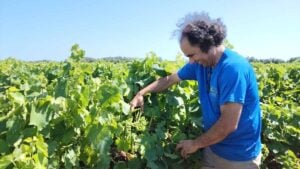
In the heart of Languedoc Roussillon, close to Béziers, Domaine la Colombette is mostly composed of new resistant types of grape. This large estate keeps its promise for true organic viticulture, without compromising its high output.
With this article, we introduce a new contributor to BKWine Magazine, Alexandra Portlock.
Read more in Alexandra Portlock’s article on BKWine Magazine: Resistant grape varieties at Domaine la Colombette reduces the need for spraying.
Conca de Barberà in Catalonia: trepat and many other great wines from these producers, part 1 | Britt on Forbes

“During my visit to Conca de Barberà in Spanish Catalonia in April this year, I met some very enthusiastic and ambitious wine producers. They all want to emphasise their region’s grape varieties and style. They are showing us that the cava grapes, especially parellada and macabeu, make brilliant still wines. The red Trepat grape, unique to Conca de Barberà, is adaptable in the face of climate change and makes light red wines with low alcohol levels and lots of drinkability, precisely what many consumers are looking for. But it can also be more “serious”. It is a fairly small region so the number of producers is limited. But at the same time, it is a very talented bunch.”
Read more in Britt’s article on BKWine Magazine, originally published on Forbes: Conca de Barberà in Catalonia: trepat and many other great wines from these producers, part 1 | Britt on Forbes.
Conca de Barberà in Catalonia: trepat and many other great wines from these producers, part 2 | Britt on Forbes
We started the story on Conca de Barberà in Catalonia, the historic Catalan wine region with its peculiar geography—a basin shielded by mountains, in the previous article. The history goes back to a medieval revival by monastic orders, and continues through recovery from phylloxera via pioneering cooperatives and their architectural landmarks, the “wine cathedrals”, to end up in today, with a celebration of its native trepat grape. Here’s the second instalment on some of the leading producers.
Read more in Britt’s article on BKWine Magazine, originally published on Forbes: Conca de Barberà in Catalonia: trepat and many other great wines from these producers, part 2 | Britt on Forbes.
A new wine with an old history, CMC Conti Marone Cinzano Brunello di Montalcino at Col d’Orcia | Per on Forbes

Taking over at a historic wine estate from a legendary winemaker cannot be easy, and for the moment, father and son work together, Francesco Marone Cinzano and his son Santiago at Col d’Orcia in Brunello di Montalcino. But already Santiago is making changes. Earlier this year, he launched a new and very ambitious project, a wine called “CMC Conti Marone Cinzano”, which is even outside the Col d’Orcia stable, competing for the top spot in quality. It cannot have been easy (not least for legal reasons, I’ll come to that later). However, it was a very important personal venture that Santiago created in honour of his father and family. I met Santiago Marone Cinzano earlier this year, when he had just launched the wine. It was a fascinating story he told me.
Read more in Per’s article on BKWine Magazine, originally published on Forbes: A new wine with an old history, CMC Conti Marone Cinzano Brunello di Montalcino | Per on Forbes.
—
Wine Tours
—
Details on our current and future wine tours. Book a wine tour with the “World’s Top Wine Tour Operator” today (or when you feel like travelling to wine country).
Treat yourself to an unforgettable experience in the beautiful wine-lands together with some of the most knowledgeable wine people around. Book now!
—
Discover the prestigious wine region of Bordeaux | wine tour

Last minute. Book now!
If you hurry, you can still register for our Bordeaux tour, which starts at the end of September. Over five days, you will discover prestigious châteaux, enjoy gorgeous lunches at Château Lascombes, Château Beychevelle, Château Haut-Bailly, and Château Franc Mayne, and indulge in tastings at yet more châteaux. You will also meet some smaller wine producers who will tell you how the actual hard work in the vineyard is done. We also take a quick drive down to Sauternes for some noble rot wines.
Don’t miss this opportunity!
Come and discover French wine and food in Bordeaux on this luxurious wine tour with BKWine, one of the world’s leading wine tour operators (*).
Book now!
(*) And the only one who has authored 13 award-winning wine books, one of which is on Bordeaux wines.
New Zealand – world-class sauvignon blanc and pinot noir | wine tour

Despite its small size, New Zealand has made a significant mark on the wine world. The country has almost as much acreage of sauvignon blanc as France, and it is mainly in Marlborough that this grape thrives. Wines with freshness and hints of tropical fruit are produced here, and sometimes with impressive complexity. It was precisely sauvignon blanc that made New Zealand a wine country to be reckoned with. Until the 1990s, wine production was very small. And the big grape was, surprise surprise, the German müller-thurgau. Today, it is almost gone, and sauvignon blanc, pinot noir, riesling, cabernet sauvignon, syrah and more have taken its place.
Join us on an unforgettable tour in March and discover the country’s diversity of wine regions and grape varieties. In Central Otago on the South Island, pinot noir has found its perfect place, with wines that can compete with the best from Burgundy. In Hawke’s Bay, you’ll discover flavourful syrah and generous chardonnay, while Martinborough also excels with its elegant pinot noir. On Waiheke Island, just a short boat ride from Auckland, you’ll find powerful cabernet sauvignon. During the trip, we will experience both islands and enjoy the magnificent scenery that makes New Zealand so special. It is a journey filled with discovery, taste sensations, and natural beauty.
Come on this stunning wine tour to New Zealand with Britt and Per of BKWine, one of the world’s leading wine tour operators (*).
Book now!
(*) And the only one who has authored 13 award-winning wine books.
More inspiration: You can get an even better feeling for what you will experience on this tour if you visit the latest tour’s own Facebook group. Lots of pictures and videos from the tour (join the group and you’ll get an update when we post new contents): The wine tour to New Zealand 2025.
From Burgundy to the Rhone Valley: world-famous French wines and villages | wine tour

Our tour begins in Burgundy, a region renowned for its exceptional wines, beautiful vineyards, and world-famous villages, including Gevrey-Chambertin, Meursault, and Vosne-Romanée. We’ll stay for four nights in Beaune, a town with a cosy, small-town vibe yet a global reputation thanks to its celebrated wines. Just a short stroll from the town centre, you are surrounded by vines.
From Burgundy, we head south to the Rhône Valley, ending in Avignon. We make a stop in the village of Tain l’Hermitage for a Northern Rhône experience, and then we continue down to the Southern Rhône, which is nowadays an exciting place, buzzing with energy. Once known for simple, affordable wines, the region now boasts stars whose bottles fetch high prices, though great value can still be found. If you are into grenache, syrah, or cinsault, this is the place. Along the way, we will meet passionate producers, savour Provençal cuisine, explore the Papal Palace, and soak in the stunning scenery.
Come on this exceptional tour to two of the world’s most respected wine regions with BKWine, one of the world’s leading wine tour operators (*).
- Burgundy – Rhone Valley Wine Tour, 23 September -1 October, 2026 (detailed programme will be available soon)
Book now!
(*) And the only one who has authored 13 award-winning wine books.
—
Bespoke Tours
(examples – we do others too)
—
Forget the myths, learn the truth and reality of Champagne | wine tour *

There are many myths and misconceptions about champagne. Let’s look at some? “Small, fine bubbles are a sign of quality.” Wrong. It could be a sign of a specially prepared (etched) or towel-dried glass (or some other effects) but it doesn’t tell you anything about the taste. “There are 49 million bubbles in a bottle.” No, it depends on many different factors, such as bubble formation points (nucleation sites) in the glass. And one of the big ones: “Grand cru is a sure sign of quality in champagne.” No, grand cru is an obsolete designation in a now abolished price control system. The quality depends primarily on the person who makes the wine. “There are seven, no, now with voltis, eight permitted grapes.” No, it’s actually nine. “The grape variety is no longer called pinot meunier but just meunier and it’s not a pinot at all.” Wrong. The grape variety is still called pinot meunier (sometimes meunier for short) and is actually technically (genetically) the same as pinot noir. You can dive into all this when you come to Champagne.
But the most important thing about champagne is that it is an outstanding wine. It is a fantastic wine in itself but also something that goes perfectly with food, as you will discover at our delicious gastronomic lunches. A champagne tour like no other with the people who wrote one of the most comprehensive book on champagne ever.
Come on this luxurious wine tour to Champagne with BKWine, one of the world’s leading wine tour operators (*).
(*) And the only one who has authored 13 award-winning wine books.
Tuscany, gentle hills with beautiful vineyards and olive trees | wine tour *

Vineyards are part of the Tuscan landscape. Grapevines thrive on the hills where the soil is poor but the sun exposure is excellent. The landscape is quite mountainous in places. The vines are grown between 200 and 600 meters above sea level. How the wine tastes depends on many factors: the grapes, the altitude, the soil and not least the philosophy of the wine producer. There are great variations in Tuscany and the producers like to emphasise these differences that the various districts within Tuscany have. Everyone is proud of their special part of Tuscany. Chianti conquered the world in the 70s with its straw-covered bottle. At that time it was known as an easy-drinking and unpretentious wine. Today we get Chianti in all versions, from top quality prestige wine to uncomplicated fruity lunch wines. The occasion will decide. We will of course visit both Chianti and Chianti Classico (two different geographical areas) and also Montalcino a little further south, known for its fantastic Brunello di Montalcino. Discover the enchanting Tuscany with us; not only the wines but also the landscape, the people and the gastronomy.
Come on this wonderful wine tour to Tuscany with BKWine, one of the world’s leading wine tour operators (*).
(*) And the only one who has authored 13 award-winning wine books.
Piedmont, the land of truffles and fog; and Barolo, Barbaresco | wine tour *

It is a beautiful landscape that meets us in Piedmont. The region certainly merits its name, “at the foot of the mountain”; the Alps tower at the horizon. The signature grape Nebbiolo also has good reason for its name; it is often foggy (nebbia) in the mornings in the hills. The Alps to the north are not far away. Around us lie medieval villages such as Barolo, La Morra, Serralunga, Gavi with their impressive defensive castles, often real fortresses. The autumn landscape is magnificent. Nebbiolo and the other grapes often grow on slopes, sometimes really steep. We taste our way through many fantastic wines, Barolo, Barbaresco and other nebbiolos, as well as slightly lesser-known but equally outstanding wines with arneis, barbera, dolcetto, etc. We enjoy the local cuisine. We visit the truffle market in Alba with its overwhelming scent experience (can you over-dose in truffles?) and we eat a delicious closing lunch with the famous white truffle.
Come and discover all the good things that Piedmont has to offer on this wonderful wine tour with BKWine, one of the world’s leading wine tour operators (*).
(*) And the only one who has authored 13 award-winning wine books.
Douro Valley: The unique landscape that cannot be described but must be seen | wine tour *

The Douro Valley impresses like few other wine regions. There is probably no other wine region that has so many steep slopes in such a large area. The Douro Valley must be seen with your own eyes. No pictures can really do it justice. When it comes to the Douro Valley, the word unique can be used without hesitation. On these difficult-to-work slopes, port wine has been made for many centuries. The “regular” (not fortified) red and white wines, called simply “Douro wines”, have not been known for as long. This combination of Douro wines and port wines makes this tour particularly interesting. We taste all types of wines. The red and also the white Douro wines (non-fortified wines) are fantastic. For many, port wines are an exciting (re-)discovery. You don’t always realise that port wine comes in so many different types and, for instance, what the differences are between an old tawny and a vintage. Completely new dimensions open up. We stay two nights in Porto, an exciting city to explore. On the other side of the river lies Vila Nova de Gaia and this is where the big port wine houses age their wines. We stay two nights at the luxurious Vintage House in the valley, close to the vineyards.
Come and discover the spectacular landscapes and wines of the Douro on this wine tour with BKWine, one of the world’s leading wine tour operators (*).
(*) And the only one who has authored 13 award-winning wine books.