Conca de Barberà in Catalonia: trepat and many other great wines from these producers, part 2 | Britt on Forbes

Share / Like:

Share / Like:

We started the story on Conca de Barberà in Catalonia, the historic Catalan wine region with its peculiar geography—a basin shielded by mountains, in the previous article. The history goes back to a medieval revival by monastic orders, and continues through recovery from phylloxera via pioneering cooperatives and their architectural landmarks, the “wine cathedrals”, to end up in today, with a celebration of its native trepat grape. Here’s the second instalment on some of the leading producers.

Producers included in this article:

  • Vins de Pedra/Marta Pedra
  • Castell d’Or
  • Celler Rendé Masdéu
  • Cellers Domenys
  • Mas de la Pansa
  • Familia Torres

In the first article on the Conca de Barberà producers you could read about

  • Celler Carles Andreu
  • Mas Josep Foraster
  • Vidbertus

You can also read my introduction to the region of Conca de Barberà: Trepat In Conca De Barbera, A Catalan Grape Variety In Tune With The Times

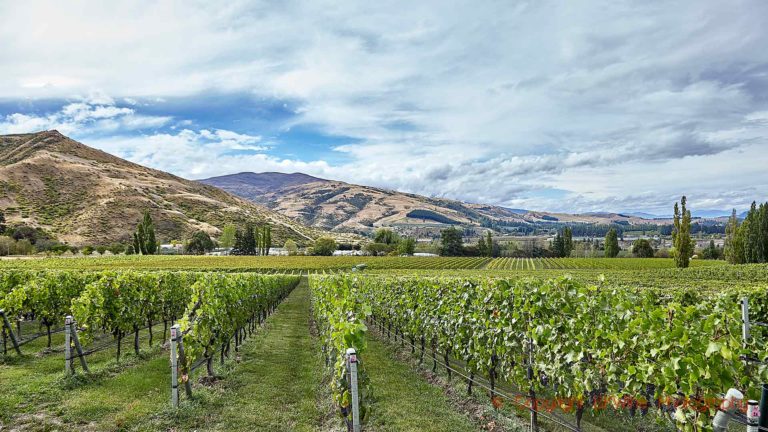
The landscape around Vins de Pedra in Conca de Barbera, Catalonia
The landscape around Vins de Pedra in Conca de Barbera, Catalonia, copyright BKWine Photography

Vins de Pedra/Marta Pedra

Marta Pedra’s wine roots go back to her great-grandfather, an entrepreneur who made wine, started a distillery and was very successful in the export market. “He managed the phylloxera crisis thanks to his trade with Argentina. He started importing wines from Argentina instead”, says Marta.

The Spanish Civil War hit the family wine business hard, and eventually it was shut down. Marta’s parents revived it in the 1980s, around the time Marta was born. And apparently, they inspired their daughter because Marta studied agriculture, and in 2002, she met Josep Serra, her partner, and they started their first wine project together, La Vinyeta.

But Marta also wanted to do something with her family heritage. She started her own project in 2010, which she calls Vins de Pedra, making wines from her family’s vineyards in Conca de Barberà planted with trepat, parellada, macabeu, garnacha blanca, muscat, cabernet sauvignon, merlot, and chardonnay. She has planted xarel-lo, the third classical cava grape which is quite unusual in Conca de Barbarà. She stresses the importance of soil, the cool summer nights, and the wind in the region.

Marta’s wines are skilfully made, but not only that, they also have plenty of personality. These are wines you remember. 40% of the production is exported.

Marta Pedra and Josep Serra i Pla of Vins de Pedra, Conca de Barbera, Catalonia
Marta Pedra and Josep Serra i Pla of Vins de Pedra, Conca de Barbera, Catalonia, copyright BKWine Photography

The wines

Picapedra Blanc 2023, Marta Pedra

100 % parellada. Late harvest, picking end of October. Grown on clay/alluvial soil. Here, parellada is expressive, even though Marta says, “it is normally a non-expressive grape”. She has a little bit of skin contact in the press and ferments in stainless steel. With its hint of saltiness, this is a fresh, delicious wine.

Picapedra Trepat, Marta Pedra

Trepat is here blended with garnacha. These varieties go very well together, according to Marta. And they do. A light red colour with aromas of red fruit, some spices, and a good freshness. (~9,50 euro).

Folls Blanc 2023, Vins de Pedra, Conca de Barberà

A creamy and delightful macabeu wine with good mouthfeel.

Folls Negre 2024, Vins de Pedra, Conca de Barberà

A superb and very juicy blend of garnacha and trepat.

L’Orni 2023, Vins de Pedra, Conca de Barberà

A blend of chardonnay and parellada. “This wine doesn’t need so much wood; we do batonnage (stirring the lees) in stainless steel, and a small percentage is aged in barrel”, Marta explains. She does an early harvest at the end of August, beginning of September, for balanced ripeness in the grapes. Lovely mouthfeel and more tropical in the aromas.

Trempat Negre 2023, Vins de Pedra, Conca de Barberà

There is a considerable concentration of aromas in this Trepat wine. She does a green harvest in July to ventilate the canopy and lower the risk of fungus. But it also reduces the yield. It is spicy, floral, elegant, and long in the mouth (~50 euro).

Korni, Trempat (Trepat) and La Musa from Vins de Pedra, Conca de Barbera, Catalonia
Korni, Trempat (Trepat) and La Musa from Vins de Pedra, Conca de Barbera, Catalonia, copyright BKWine Photography

Castell d’Or

The wine cooperatives have played an important part here, as in many other wine regions in Europe, and still do. Castell d’Or in the village of Barberà de la Conca belongs to a group of 16 cooperatives in Penedès and Tarragona. Most of the wine is sold in bulk to the cava houses. Castell d’Or was founded 20 years ago with the aim of bottling more of the members’ grapes. The group wants to sell less and less in bulk and more and more in bottles. For now, Castell d’Or exports to Belgium, Japan, and the USA, among other countries.

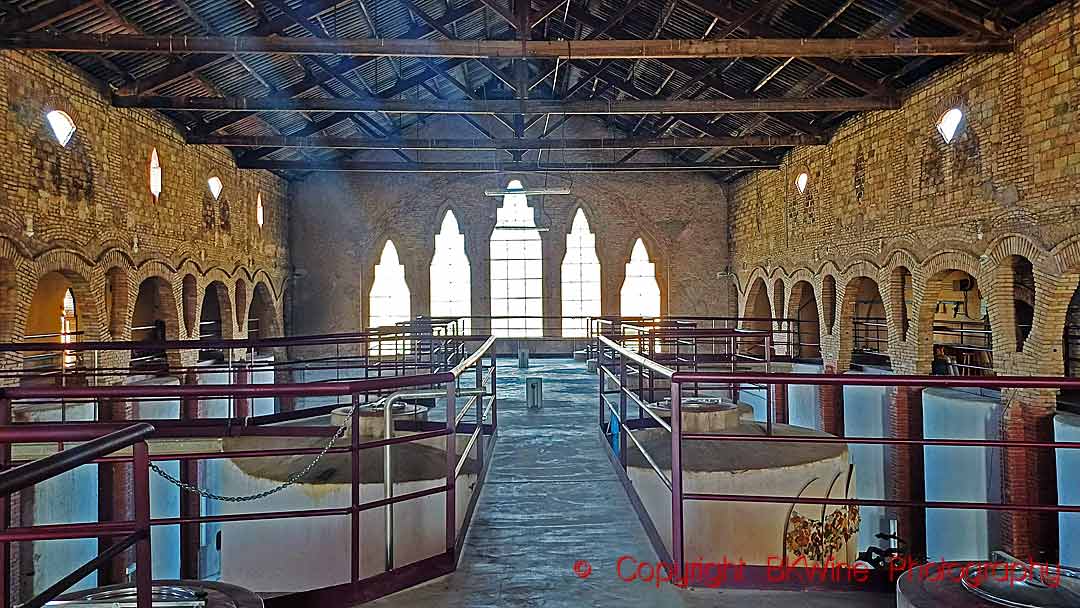
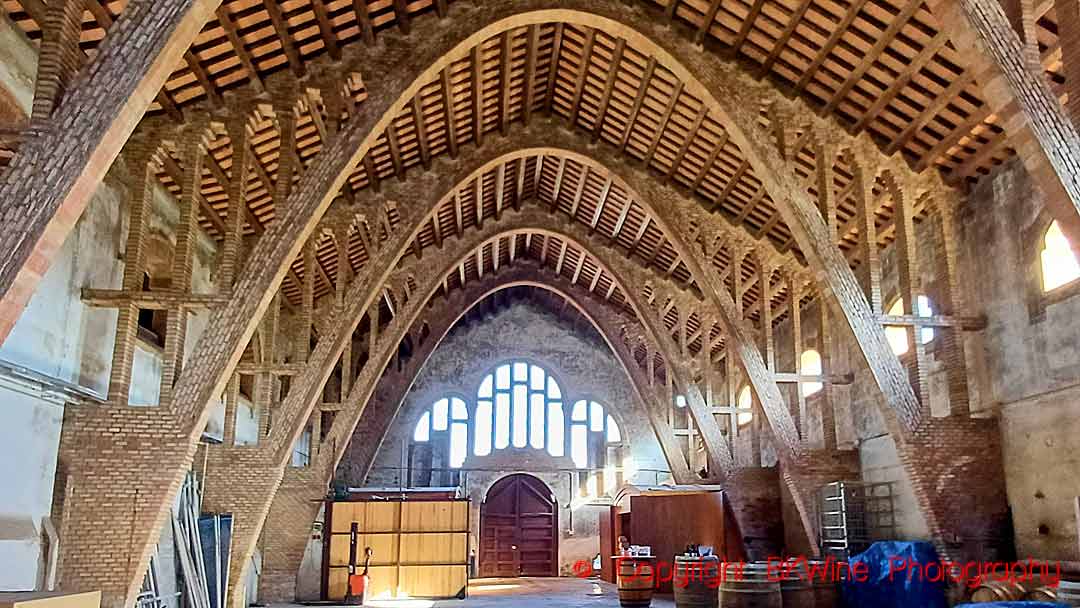
The striking wine cellar, a wine cathedral designed in 1920 by Cesar Martinell, a disciple of Gaudí, is declared a monument. Here, the cooperative also gives space to wine makers starting on their own. They can share the cellar and the installations here for five years. During this time, they gain experience and can decide whether to continue.

Here in Conca de Barberà, says Gonzalo Cle de Diago, the commercial director, red Trepat became fashionable when the smaller, independent wine growers started making it. “Until that moment, trepat was basically used only to produce rose cava or rose wine. “Because cava was a secure market, making red wine from Trepat was like a revolution; it was a change for not only us, but also for the DO Conca de Barberà.”

“As light red wine is popular now, we have had a positive response with our red Trepat. It is a very adaptable grape; it adapts better than many varieties to climate change and to different soils.”

Gonzalo stresses that they do not use any irrigation, they cannot get water, the area does not have these resources. Maybe in future, he says, there are ongoing projects for desalination from the government. In the meantime, it’s best to stick to adaptable grape varieties.

The wines

Rosé Trepat 2024, Castell d’Or, Conca de Barberà

A flavourful rosé wine, light in body, but packed with red fruit and quite long in the mouth (~7 euro).

Castell d’Or Trepat 2024, Conca de Barberà

Easy-drinking, still with character and lots of fruit, juicy in a pleasant style. Ferment in stainless steel tanks (~7 euro).

Castell d’Or also makes a red Trepat with fermentation in oak barrels, which slightly changes the style, giving it a good mouth feel and more complex flavours. Another style of Trepat.

The "wine cathedral" (winery) at Castell d’Or, Conca de Barbera, Catalonia
The "wine cathedral" (winery) at Castell d’Or, Conca de Barbera, Catalonia, copyright BKWine Photography

Celler Rendé Masdéu

The roots of the company go back to the beginning of the 20th century. Josep M. Rendé was a Catalan agronomist who was involved in founding the first agricultural cooperatives in the region. We leap to modern days. In 1991, the brothers Josep M. and Joan Rendé Masdeu decided to make their own wines. Another leap to the dramatic events in October 2019, the flooding of the Francolí River, which totally devastated their winery. Some fermentation tanks were washed away and found later downstream and are now like a modern abstract sculpture in the garden. 

With a lot of help from other wineries from all over Catalonia, they managed to restart their activities. They also managed to save some bottles (they sell them as the Mud Wine!). In 2020, they moved to a new winery between L’Espluga de Francolí and Montblac.

Here, Guillem Roig Josa is the oenologist, and he makes around 75,000 bottles a year, “but because of the drought, the last three years have been more like 50,000 bottles, he says. This year (2025) looks good, though, he adds, it has already (in April) rained 300 mm.

The wines

Rendé Masdéu Reserva Superior Brut Nature 2021, DO Conca de Barberà

A sparkling wine from the DO Conca de Barberà (still unusual as most producers here make cava when they make sparkling). With Trepat and Parellada. Delicious, savoury, and fresh.

La Nimfa blanc 2024, Celler Rendé Masdéu

Macabeu, Garnacha blanca and Trepat give here a fresh, floral wine with green apple aromas and a certain structure.

Genuïna 2023, Celler Rendé Masdéu

Garnacha blanca and Trepat with fermentation and ageing in oak. White fruit aromas, litchi, structured with balanced oak influence.

El Follet Rosat, Celler Rendé Masdéu

Syrah with short skin maceration of only 8 hours. Like a fruit basket and fresh notes of tomato sprigs.  

Trepat del Jordiet 2022, Celler Rendé Masdéu

This Trepat spent 8 months in amphora. Red fruit, pepper, fresh herbs, fennel, easy-drinking and pleasant. 11,5% alc

The tank that was crushed by the flood at Celler Rendé Masdéu, Conca de Barbera, Catalonia
The tank that was crushed by the flood at Celler Rendé Masdéu, Conca de Barbera, Catalonia, copyright BKWine Photography

Cellers Domenys

This is a union of 8 cooperatives, three in Conca and four in Penedès. The union comprises 800 farmers, 2500 hectares of vineyards, and 400 hectares of olive trees. The winery is in the village of Rocafort de Queralt, in a 1917 building, a so-called wine cathedral by the architect, Cesar Martinell.

These wine cathedrals are so special for the region that Cellers Domenys is planning a museum for Martinell, which will be made into “a stop for wine lovers, with restaurant, tasting room and of course the possibility to learn about the wine cathedrals”, says Josep Almirall, the export manager. They will also build a small winery separated from the main winery, for production of 30,000 bottles. Here they will make all kinds of interesting wines for a different public.

The wines of Cellers Domenys have been in the market since 2019. 80% is domestic sales. The rest goes to Belgium, the United Kingdom, the rest of Europe, the US, Canada, Mexico, and soon they will have an importer in Japan. “But it is a long process”, says Josep. Cellars Domenys makes 500,000 bottles, of which 100,000 are Cava. The rest is sold in bulk, but they want to sell more in bottles, and Josep is dreaming of getting away from bulk as much as possible.

The wines

Cellers Domenys Anima Nua Cor Viu 2023

Macabeu and Parellada are picked and fermented separately in stainless steel tanks and then spend a couple of months in oak barrels with batonnage and they are bottled in June. A lovely wine with volume in the mouth, fresh acidity, flavours of green apples and grapefruit. A perfect food wine, according to Josep: “It goes with a lot of things and Spanish people eat a lot of different things at the same time”.

Domenio Anima Nua Cor Viu

A blend of Ull de Llebre (local name for Tempranillo) and Trepat, aged for some time in big oak barrels for the microoxygation, not for the oak flavours. A delicious, refreshing, easy-drinking wine for any occasion.

Domenio Trepat 2021

A single vineyard wine with 60-year-old vines. Fermentation is in small 500-litre oak barrels, and only 1,000 bottles are made. Structured with fresh acidity and length, the oak is well integrated, and the overall impression is of a balanced, delicious wine with the red fruit aromas that are characteristic of trepat. (15 euro)

Cellers Domenys cellar, "wine cathedral" in Conca de Barbera, Catalonia
Cellers Domenys cellar, "wine cathedral" in Conca de Barbera, Catalonia, copyright BKWine Photography

Mas de la Pansa

Imma Soler had a dream. Instead of just selling the grapes from the family vineyard, she wanted to make her own wine. Which she now has been doing since 2016. From 60-year-old bush vines, she makes flavourful Trepat from Conca de Barberà and also Macabeu and Parellada from the neighbouring region of Alt Camp. All these three varieties have their distinct personality, says Imma. She has 5 hectares and works sustainably, using natural products to treat the vineyard. Her wines are full of life and character.

Trepat Tinto 2020, Mas de la Pansa, Conca de Barberà

The family planted this vineyard in 1957 on a northern slope. There is vitality and energy in the wine, a lot of freshness, red berries, and fresh herbs. “The important thing is to pick at the right moment”, says Imma.

Imma Soler of Mas de la Pansa, Conca de Barbera, Catalonia
Imma Soler of Mas de la Pansa, Conca de Barbera, Catalonia, copyright BKWine Photography

Familia Torres

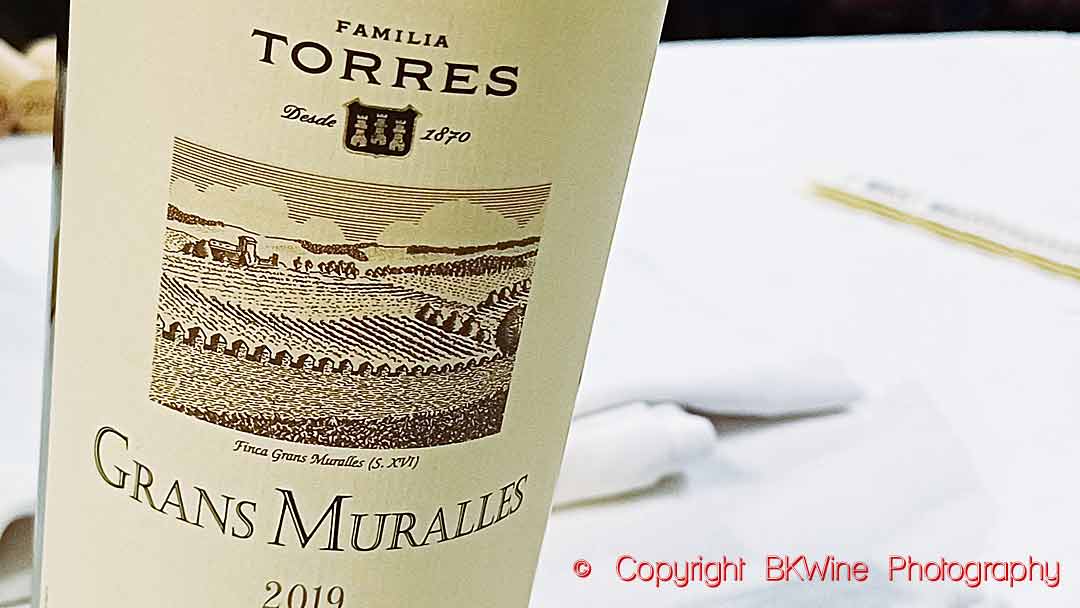
The last wine I want to present is maybe the most famous of all Conca de Barberà wines: Grans Muralles from the Familia Torres, the famous Catalan family, one of the most renowned Spanish wine producers.

The project Gran Muralles started in the early 1980s, aiming at recovering old and forgotten Catalan grape varieties (a passion project of the Torres family). In Grans Muralles, two of these forgotten grapes, the Garró and Querol varieties, are used together with Cariñena, Garnacha, and Monastrell. They are all vinified and aged separately. The vineyard is composed of a very particular slate and granite soil.

Grans Muralles 2019, Familia Torres

A smooth, silky, complex wine with intensity and layers of aromas, lots of fruit, and a good backbone structure. The “Muralles” are the medieval walls of the extraordinary Poblet Monastery that surround the Torres Conca de Barberà vineyard.

Familia Torres Grans Muralles, Conca de Barbera, Catalonia
Familia Torres Grans Muralles, Conca de Barbera, Catalonia, copyright BKWine Photography

Chose your language. Read the article in:

Author:

Author:

Share this post:

Leave a Reply

Your email address will not be published. Required fields are marked *

  Subscribe to comments:

Notify me of followup comments via e-mail. You can also subscribe without commenting.

Related posts:

Explore more from BKWine:

SUBSCRIBE TO OUR NEWSLETTER!

25,000 subscribers get wine news every month. You too?