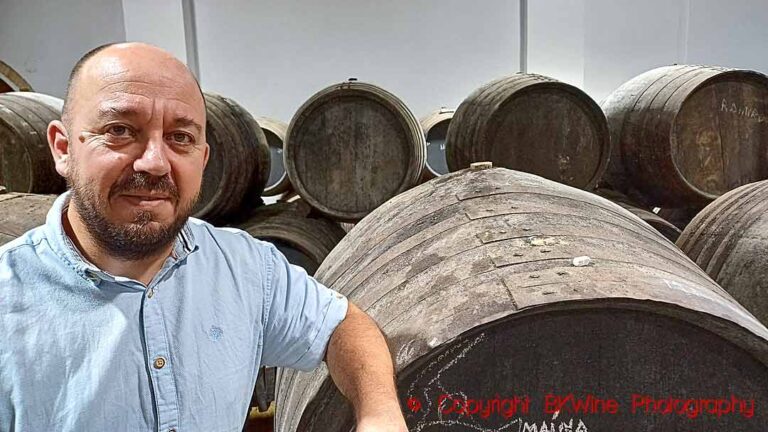
Taking over at a historic wine estate from a legendary winemaker cannot be easy, and for the moment, father and son work together, Francesco Marone Cinzano and his son Santiago at Col d’Orcia in Brunello di Montalcino. But already Santiago is making changes. Earlier this year, he launched a new and very ambitious project, a wine called “CMC Conti Marone Cinzano”, which is even outside the Col d’Orcia stable, competing for the top spot in quality. It cannot have been easy (not least for legal reasons, I’ll come to that later). However, it was a very important personal venture that Santiago created in honour of his father and family. I met Santiago Marone Cinzano earlier this year, when he had just launched the wine. It was a fascinating story he told me.
Let’s start with the wine, CMC Conti Marone Cinzano Lot 1, 2019. The fundamental idea is to, each year, make a small number of bottles of the best of the best that can be made from the 100 hectares of sangiovese that the family owns in Tuscany. CMC “Lot 1” has been released in only 9944 bottles.
This is a longer version of an article published on Forbes.com.
To understand what this wine is, we need to take a look at the range of wines that Col d’Orcia produces today.
The base level is the regional wines called IGT, for example, IGT Toscana, Pinot Grigio, Nearco and a few more in different styles.
Then they move up to the DOC appellation with Rosso di Montalcino DOC and Banditella Rosso di Montalcino DOC
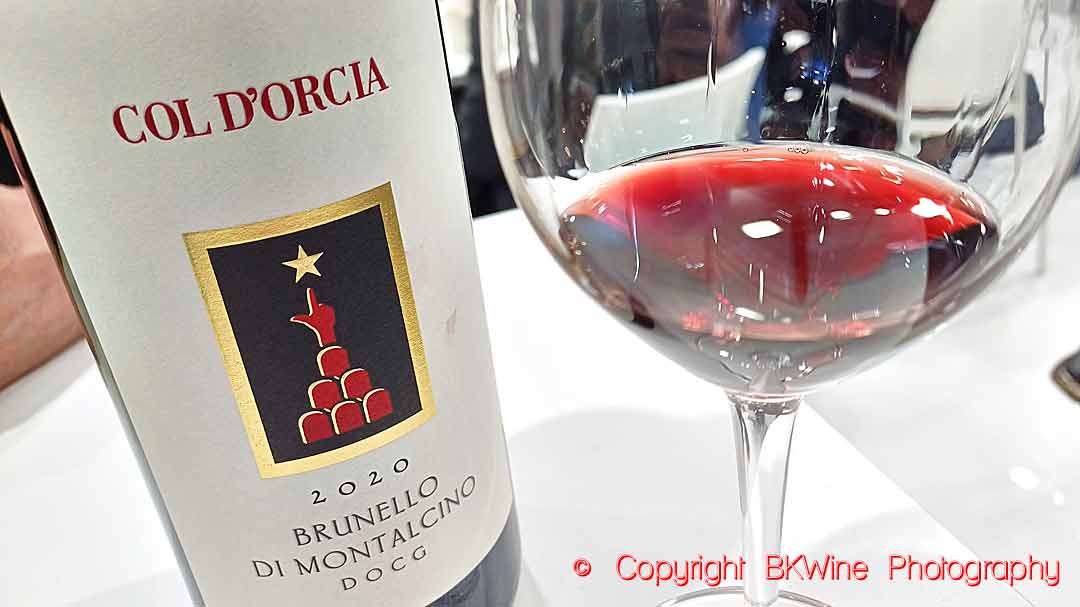
Next, they have the top-level DOCGs Brunello di Montalcino and Brunello di Montalcino Nastagio.
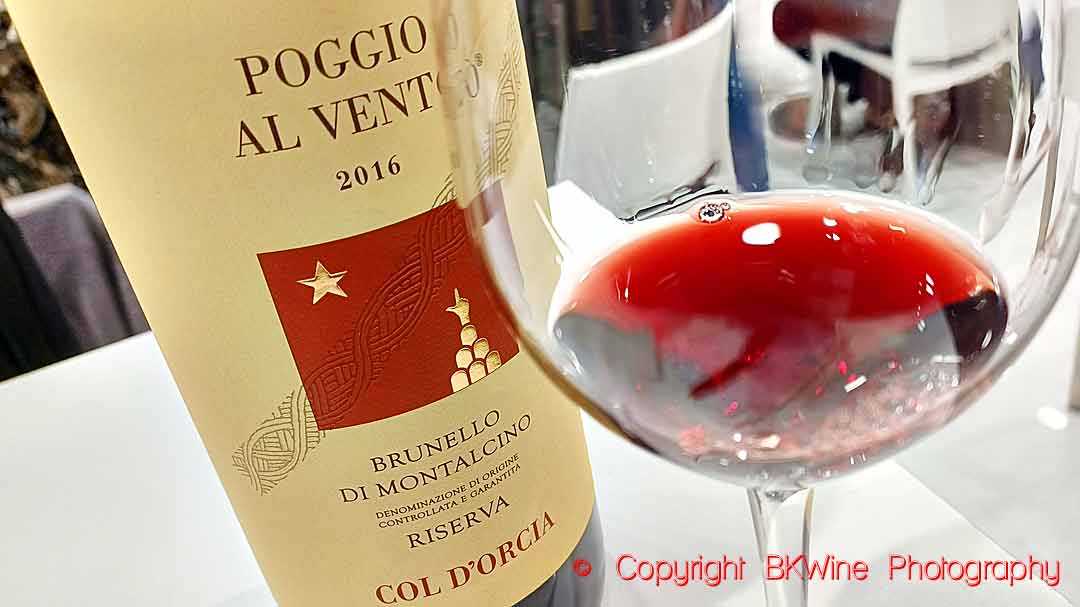
And finally, at the pinnacle of the pyramid, they have the single-vineyard Poggio al Vento DOCG Brunello di Montalcino Riserva. This always comes from the same plot, the small vineyard called Poggio al Vento.
The best of every year
The CMC Conti Marone Cinzano is different. It is, in a way, similar to the Poggio al Vento, also being a prestige cuvée at the top of the quality pyramid, but with a very different logic. It does not come from the same plot every year, so it does not have a vineyard name on the label.
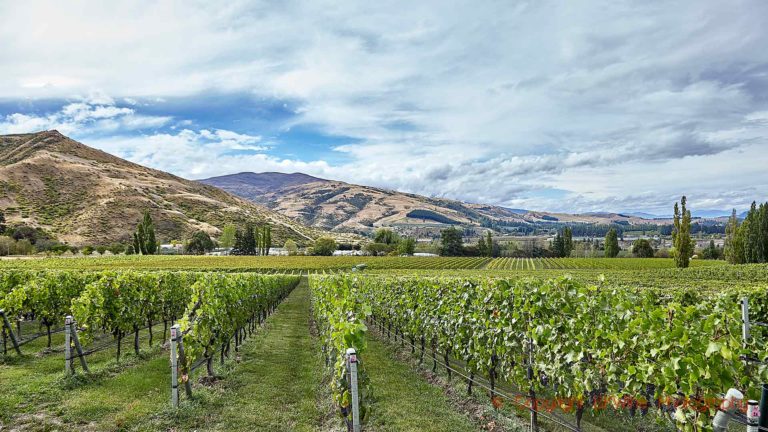
The family owns some 100 hectares of sangiovese vineyards in Brunello di Montalcino. Several years ago, they began working with Dr. Donato Lanati, a renowned agronomist, to better understand the quality and characteristics of each part of their vineyards.
Every year, they sample and analyse every different patch of vineyard to see what it gives “this year”. The performance of each patch varies from year to year due to exposure, weather, and numerous other factors. “We know very well that every vintage has a specific plot that is the best,” says Santiago Marone Cinzano, the next-generation winemaker. One year, it might be a plot high up on a hill with rich, clay soil. Another year, it can be one with more sand, with different sun exposure. This “best” plot of the year is what makes Conti Marone Cinzano CMC.
Conti Marone Cinzano is also different from the Poggio al Vento in that the CMC will be released every year. There is always a “best” plot every year. The Poggio, on the other hand, is not produced in very difficult years, for example, 2017 and 2018, when the grape material is not quite up to what Marone Cinzano wants Poggio al Vento to be. Instead, it then goes into the “regular” or classic Brunello.
Santiago explains, “We started doing a ‘micro-parcelisation’ of over 100 hectares of Sangiovese that the family owns in Montalcino. We started doing analysis on grapes from veraison (*) up until maturation, so before picking, before harvest time. We started doing analysis to identify the very best parcels of each vintage. We started doing this because there is such a climatic variability and climatic unpredictability (between the different parcels).” ( (*) veraison is when the grapes start changing colour in summer.) With this minute analysis of the vineyards, every year they select grapes from what they judge is the very best plot that particular year.
“Just a brief example,” Santiago continues, “is the following: a vintage like 2017, which was a very dry, very warm vintage, we will choose one of our higher vineyards, very clay-rich soil with hydrological retention, maybe not exposed to the southwest because it gets too much sunlight. But in a vintage like 2018 or 2014, very rainy, very fresh, we will go for sandy soil, which has nice drainage, most likely southwest exposition, so it has more hours of sunlight.”
Some of these details can be found on the bottle, allowing the wine drinker to gain a deeper understanding of what each specific vintage is about.
So, is CMC better than Poggio al Vento?
Well, that depends on what you mean by “better” and on what your personal preferences are. The two wines are certainly different.
Poggio al Vento is more “traditional” and CMC is more “modern”. Santiago explains that this is intentional, “I wanted to produce a Brunello that had two main aspects that are important for me: very silky tannin, very velvety tannin, because I see that my generation doesn’t love very tannic wines when they’re not mature enough, so, very high phenolic maturation and 50% of polymerisation of tannins before going in the bottle, AND very fruit forward. If I tell the story that this is a selection of the best fruit of the season, then I want the fruit to be the protagonist. And on the nose, red fruit is very much the protagonist.”
And yes, the CMC is indeed a very different wine. It is made in a different way than the Col d’Orcia wines. Santiago is actually making the CMC wines as a separate business. And it will be distributed and sold in a different manner.
But even so, if you want to experience the subtleties and variations of Brunello di Montalcino wines, I’d suggest that you try them both and compare. They are not only excellent wines, but they also give you an illustration of the importance of the hand of the winemaker and a glimpse into the trends of a changing wine market.
When I tasted the two side by side, the Lot 1 was full of clean, fresh fruit with soft tannins, dark fruit and had a smooth, long finish. The Poggio al Vento had clear hints of being aged in wood, of course, a bit older too (three years more) with a brownish tinge, very elegant with racy tannins, classic expression, perhaps a bit ‘hot’ with a long finish.
A new generation winemaker and a new generation wine-drinkers
This different style is not necessarily based on in-depth market research (well, maybe it is?), but more on Santiago’s personal experience: “I look at my friends who are my age; when we meet and we want to drink a bottle, they drink trousseau from Jura, they drink Beaujolais, they drink Etna reds — crisp, fresh, vertical reds. And when I bring a very traditional Brunello, often they say, ‘Oh, let’s drink this in 10 years.’ So I understand their taste profile.”
Watch the interview with Santiago Marone Cinzano here:
This reflects a thinking that Santiago Marone Cinzano is not alone with. It is questions that concern many other wine regions too. “If we only rely on the current consumer base of Brunello, chances are that in 30 years, my generation isn’t drinking it, and I will be selling a fraction of the Brunello I’m selling today. So, I want Brunello and Montalcino as a region to be very attractive to my generation. And inevitably, to achieve that attractiveness, there has to be a style of wine that is true to Brunello and it’s true to Montalcino, but at the same time, is more approachable for my generation.”
So what is Santiago’s answer to this conundrum? “I find fruit forwardness, soft tannins and a slightly more elegant and feminine style if you want to be very attractive to my generation. So that’s what we’re going for here in Lot 1.”
A revolution
But on a more personal level, the wine is even more of a revolution. The family has not been making wine under its own name for several decades. The name Cinzano is a protected trademark that the family sold, together with the vermouth inside the bottle, in the late 1980s.
Now is the first time in a long time that the name Cinzano appears in the name of a wine. Over the 50 years that the family has owned Col d’Orcia, it has not been sold under the bottle. Here’s the story.
It is easy to understand why this would feel like a momentous step, verging on a revolution. Cinzano is almost a “household” name in the drinks business; it’s the name of one of the world’s most famous vermouths. The vermouth house, including the rights to the Cinzano brand and name, was owned by the family but was sold in the late 1980s, early 1990s. As a result, the Brunello di Montalcino has not used the family name since. It was attached and the property of the vermouth business. The wine that Francesco Marone Cinzano makes at the family estate in Tuscany has always gone under the name Col d’Orcia.
The Cinzano family has a long history in Brunello di Montalcino in Tuscany. Some 50 years ago, Francesco Marone Cinzano acquired the Col d’Orcia, one of the region’s leading estates with a solid international reputation. But the history of making wine and vermouth is much older. The earliest traces are from the 16th century and in the 18th century they established a vermouth and wine business under the family name Cinzano.
Losing the family name
The sale of the company was not an easy thing for the young Francesco Marone Cinzano, Santiago’s father. For Santiago, launching this brand is obviously a very emotional step, as he told me about his personal history of it: “When I was a young kid growing up in Chile, I didn’t really know what had happened with Cinzano. But I knew it was us, because in the house I saw paintings of Cinzano’s old logos, ashtrays… And in the supermarket, I remember maybe seven, eight years old, the first time I see a Cinzano bottle — I grab it and I put it in the cart. I’m with my father, and I see my father’s face go white, and he says, ‘No, I don’t want to see that. Please take it away.’ And then I started thinking, there’s something there that was probably a sad story, something that was very difficult for him.” So, maybe, Santiago says, that moving the family to Chile was perhaps a way to get away from the memory of having to sell the company: “Ultimately, I believe that’s part of why he moved to Chile, kind of to get away from a whole situation that was very hurtful for him, and when I noticed how much it hurt him, I knew I wanted one day as a dedication to my father, to reclaim the name.”

But how?
The vermouth and the brand, the name, are now owned by Campari. The lawyers that Santiago spoke to said that it is quite impossible to use the Cinzano name in any connection with wines and spirits. What was there to do?
Santiago talked to his lawyer and said, “What if I go speak to Luca Garavoglia, the owner of Campari? Tell him about my desire, my dream, my project, and see how he reacts.” Santiago decided to go to Milan and arrange a meeting with Garavoglia. “We went to lunch. I spoke about the project, and he told me, ‘As long as Cinzano is mine, I will not complicate your life in any way. So please feel free.’ We shook our hands. He asked me to send him a bottle for Christmas, and that’s how I got the chance to use what I ultimately decided to stylise at CMC, to make it short and memorable. So Conti Marone Cinzano, the family brand.”
So, today, the Cinzano family name is finally back on the label of a bottle made by the family.
Read more on Col d’Orcia in these BKWine Magazine articles:
- Brunello di Montalcino from Col d’Orcia, a tasting with count Francesco Marone Cinzano
- Col d’Orcia vertical tasting: Brunello di Montalcino 1980-2015
- Zoom in on Col d’Orcias Rosso and Brunello di Montalcino
- Tenuta Col d’Orcia, a leading producer of Brunello in Montalcino
- Col d’Orcia – a winery in Montalcino, Tuscany