Chateau Kamnik, a pioneer for North Macedonia and for vranec | Per on Forbes

Share / Like:

Share / Like:

Chateau Kamnik is one of the first wineries in North Macedonia to become internationally known and acclaimed. It is conveniently located on the edge of the capital Skopje. It is also one of the first privately owned quality-oriented wineries to be established after the end of the Cold War. However, the country has 4000 years of winemaking to look back on. A while back, I sat down and talked to their winemaker Sandra Georgievska.

For a country that has been making wine for more than 4000 years, it is perhaps strange to say that a winery that is just over twenty years old is a pioneer. If I ignore some of the regional political conflict around the name Macedonia, let’s start with describing what we could call “Greater Macedonia”. This corresponds to a region that in the south is in northern Greece, in the east in Bulgaria, and in the northwest it is the country today called North Macedonia (for a while known under the name FYROM, Former Yugoslav Republic of Macedonia). “Greater Macedonia” was once ruled by Alexander III of Macedon, better known as Alexander the Great, and this is the cause of some current tussle around the name Macedonia. But let’s return to wine – wine should unite people and not divide.

It is believed that wine was made in Macedonia 4000 years ago based on archaeological findings. Wine was important in the Roman times and there are depictions plants in the famous Stobi mosaics that may be vines.

This is a longer version of an article published on Forbes.com.

The Stobi mosaics in North Macedonia
The Stobi mosaics in North Macedonia, copyright BKWine Photography

Troubled periods

But then, in the 14th century things became more difficult. Macedonia came under Ottoman rule, and Muslims were not known for their love of wine. Wine production did not disappear altogether, of course. In the late 1800s and early 1900s Byzantium lost power and things improved. Wine made a comeback, but it was to be a relatively short flourishing, at least for the part that is now North Macedonia.

After the First World War, what was to become Yugoslavia started to take form. After the second world war, what is now North Macedonia became fully integrated Socialist Federal Republic of Yugoslavia under Tito. It was difficult times for the quality wines. Production was to a large extent nationalised or state controlled. After the end of the Cold War, wine production started to move into private hands, but it was a complicated period in the 1990s. Vineyards were not always planted with quality in mind, equipment in the wineries were not the latest. For many years, during the Cold War, the wine industry still existed but was focused on making large quantities of cheap wines. It was the production model of the Soviet Union, similarly in Yugoslavia. This virtually eliminated quality winemaking, which was only revived after the fall of the Iron Curtain.

Mortar shells in the garden of the hotel Hunter's Lodge at Chateau Kamnik
Mortar shells in the garden of the hotel Hunter's Lodge at Chateau Kamnik, copyright BKWine Photography

A new era for the country and for winemaking

So, the new era in winemaking in North Macedonia took off in the late 90s early 00s. And that brings us back to Chateau Kamnik as a 20-year-old pioneer in a country with a 4000 year old wine history.

Chateau Kamnik was founded in 2004 by Ilija Malinkovski an industrialist and wine enthusiast. It was one of the first focused on producing quality wines and remains one of the leaders. It wasn’t the very first privately owned winery with ambitions. For instance, it was preceded — but only slightly — by the confusingly named Tikveš Winery, although founded in 1885, so, probably the oldest winery still active in the country but in private hands since the early 2000s. “Confusingly named”, since Tikves is also the geographic name of a wine region.

Today, Ilija Malinkovski’s son, David Malinkovski, is in charge of running the Kamnik winery, and the wines have been made for many years by the very talented chief winemaker Sandra Georgievska. Malinkovski was already a successful business man at the time with an activity that seems to have included international trade, international arms trade, security services and equipment, outdoor equipment and various other activities.

At the winery, there is also an elegant hotel, called the Kamnik Hunter’s Lodge, with a shooting range in the basement , perhaps a reflection of the family’s interest both in hunting, arms, and outdoor life. It is in any case clear that it is a well-connected winery, considering the many famous signatures one can find on the wine barrels in the cellar, Jens Stoltenberg (ex-NATAO chief), Alexis Tsipras (ex-Prime Minister of Greece), John Malkovich (famous actor), Aleksandar Vučić (President of Serbia, who wrote “For the friendship between Serbia and North Macedonia” on his barrel…). In addition, Ilija Malinkovski is the Honorary Consul of Morocco in North Macedonia.

A wine barrel signed by John Malkovich, at Chateau Kamnik, North Macedonia
A wine barrel signed by John Malkovich, at Chateau Kamnik, North Macedonia, copyright BKWine Photography

The winery and the hotel is located just a ten minutes’ drive from the city centre of Skopje, the capital, so it’s a perfect place for a day excursion from the city or a place to stay if you want to be a bit away from the centre of town, although the garden decorations may strike you as a little bit original – there were two old mortar shells from the Second World War resting on a garden wall when I was there.

The wine chateau

But back to Kamnik as a wine producer.

As mentioned, last year, Chateau Kamnik celebrated its 20th anniversary. Founded some ten years after the end of the Cold War, it’s first vintage release was the 2008.

Chateau Kamnik is today one of the leading producers of vranec wines in Macedonia, vranec being the emblematic grape of the country.

The son of Ilija Malinkovski, director, and Sandra Georgievska, winemaker, Chateau Kamnik, North Macedonia
David Malinkovski, director and son of the owner, and Sandra Georgievska, winemaker, Chateau Kamnik, North Macedonia, copyright BKWine Photography

A little while back, when I was in North Macedonia to taste and judge in the first edition of the Vranec Selection by the CMB Concours Mondial de Bruxelles wine competition, I had the opportunity to meet with Chateau Kamnik’s winemaker, Sandra Georgievska, one of the few (too few) women winemakers I’ve met in Macedonia. I wanted to ask Sandra some questions about vranec, so we sat down in a corner of their winery, each with a glass of Kamnik’s vranec. As I mentioned, Kamnik celebrated its 20th anniversary in 2024 and Sandra has been there for fourteen years, since 2010, almost (but not quite) from the very first vintage.

Vranec is a grape variety quite unique to the Balkans. Several of the countries grow it — notably, Serbia, Bosnia-Herzegovina, Croatia, Montenegro, Kosovo — but North Macedonia has the biggest plantings. It often gives quite powerful wines with very dark colour, masses of fruit, both black and red, very sprightly acidity, and full-bodied with plenty of tannins to give structure. It is generally a wine that goes well with grilled meat, duck, stews, or other substantial dishes. However, the styles differ; you can even find wines of lighter styles that are excellent for poolside drinking (although that would be unusual). It is a grape that, in some ways, represents the essence of Macedonian wine.

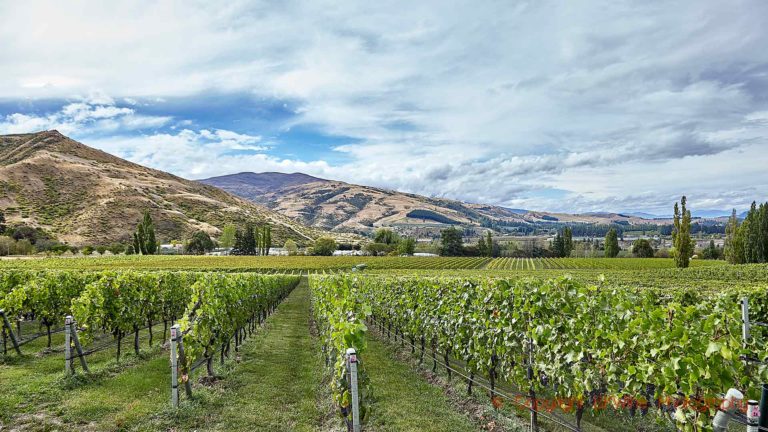
The view from Chateau Kamnik over the vineyards and Skopje, North Macedonia
The view from Chateau Kamnik over the vineyards and Skopje, North Macedonia, copyright BKWine Photography

Vranec, a fickle national treasure

I asked Sandra Georgievska if she would agree with me that vranec is like the soul of Macedonian wines, “Yes, but also, it’s very difficult for making wine because it’s very wild; in the process of fermentation and in ageing process – every day is different.” In other words, it is a grape that can give outstanding results, but as a winemaker, you have to know what you do, control the winemaking process, and not let the wine run away from you. Or as Sandra puts it, “You can make vranec for everyday drinking and vranec to drink one glass at the end of the dinner with a cigar or selected cheeses. So, vranec is a very blessed variety to make different types of wine.”

Watch the whole interview with Sandra Georgievska on this video:

What, then, is it that Sandra tries to bring out in her vranec wines?, I asked. “I want it to taste in harmony — like every other wine. But, for vranec in particular, you have to feel the muscles and the heavy body and the oiliness and concentration of the anthocyans. Because it’s almost black. And on the other hand, to feel the harmony and not feel the alcohol. Like in amarone-style — there you feel the alcohol and sugar. But here (in vranec) you feel the freshness, the body, and also everything to be silky. It was very nicely said by one of the masters of wines: it is an iron fist in a velvet glove.”

Grapes bunches on a vine in North Macedonia ready for harvest, may be vranec/vranac or something else
Grapes bunches on a vine in North Macedonia ready for harvest, may be vranec/vranac or something else, copyright BKWine Photography

Kamnik and vranec, two stars, but not alone

Chateau Kamnik, like most wineries in North Macedonia, makes a wide range of wines, not only vranec. You can find cabernet sauvignon, riesling, pinot noir, etc, as well as local varieties like temjanika, kratoshija, zhilavka, smederevka and more.

But this “wild” vranec, does it have any particular challenges for a winemaker, so as not to let it go too wild? Sandra explains, “Comparing it with different varieties like syrah and merlot – (with these varieties) you know what will happen in fermentation and after fermentation.” But vranec is not so easy… Sandra continues, ”Vranec took me years to understand, that it’s a fighter. It’s changing a lot. One day, when you taste it, it will be open, like it’s oxidating. And if you don’t analyse the wine, you will think it needs sulphites to conserve the wine. And another day, it’s reductive (ed.: the opposite oxidative), like closed without oxygen, so that it needs more oxygen, you need to bring oxygen for it to open up. So, it just needs patience and time and proper ageing in barrels.”

Sandra Georgievska, winemaker at Chateau Kamnik, Macedonia, with an experimental rosé
Sandra Georgievska, winemaker at Chateau Kamnik, Macedonia, with an experimental rosé, copyright BKWine Photography

Talking to Sandra, who’s been making the wine for fourteen years, it certainly seems like a complicated wine to make. But one that is certainly worth the while, thinking of the result. And as Sandra pointed out, it needs patience, not only from the winemaker but also from the consumer. It can be a fabulous wine for ageing in the cellar. And, of course, for drinking.

Today, twenty-one years later, Chateau Kamnik remains one of the leaders, but now there is a wealth of other exciting wine producers making quality wines in North Macedonia, many of whom, no doubt, inspired by Chateau Kamnik.

A wine barrel signed by Aleksandar Vučić, at Chateau Kamnik, North Macedonia
A wine barrel signed by Aleksandar Vučić, president of Serbia, at Chateau Kamnik, North Macedonia, copyright BKWine Photography
Vranec/vranac grapes on a vine in North Macedonia ready for harvest
Vranec/vranac grapes on a vine in North Macedonia ready for harvest, copyright BKWine Photography
A wine barrel signed by Alexis Tsipras, at Chateau Kamnik, North Macedonia
A wine barrel signed by Alexis Tsipras, at Chateau Kamnik, North Macedonia, copyright BKWine Photography
A wine barrel signed by Jens Stoltenberg, NATO, at Chateau Kamnik, North Macedonia
A wine barrel signed by Jens Stoltenberg, NATO, at Chateau Kamnik, North Macedonia, copyright BKWine Photography
Per Karlsson, one of the judges at the Vranec Selection by CMB in Veles, North Macedonia
Per Karlsson, one of the judges at the Vranec Selection by CMB in Veles, North Macedonia, copyright BKWine Photography

Chose your language. Read the article in:

Author:

Author:

Share this post:

2 Responses

  1. We were privileged to taste your wine in one of the Skopje Restaurants, I must admit having taken a high degree in Napier university in Edinburgh Scotland for wine and spirits I was pleasantly surprised of the complexity of your Gold Temjanika . Simply stunning wine not just for the appearance but mainly for the taste. Thank you Sandra for putting Macedonia on the map of great wines. Sadly we couldn’t find it in Britain . I suppose we will have to suffer until our next trip to Macedonia but this time we will visit Chateau KAMNIK and taste the wines. ❤️

    1. Toni,

      Perhaps I need to point out that this, BKWine Magazine, is a wine magazine, publishing journalism and stories about wine. We are in no way related to Chateau Kamnik.

Leave a Reply

Your email address will not be published. Required fields are marked *

  Subscribe to comments:

Notify me of followup comments via e-mail. You can also subscribe without commenting.

Related posts:

Explore more from BKWine:

SUBSCRIBE TO OUR NEWSLETTER!

25,000 subscribers get wine news every month. You too?