The White Label and the Blue Collar

Share / Like:

An essay on the charms and joys of working as a winery intern (“cellar rat”) during harvest time

Picture a huge steel French press, about seven feet long and three feet high, held sideways about six feet off the ground. It looks quite a bit like a small submarine. A sliding door on the side of the chamber is opened and positioned under a huge metal funnel. This is a winery press, and it falls to you and a forklift operator to load it for the third time today. You muscle your way up onto the press, grabbing the metal scaffolding to lift yourself to the funnel. Below your feet, the press looms. The machine contains a kevlar balloon which fills with air, forces liquid from the grapes, through steel grates, and into a catch tray below. The press chamber is held by a large cradle which, when powered, rotates the chamber under pressure to extract juice.

A coworker hands you up a plastic hoe, and you lean back and watch silently as the cellarmaster lifts a thousand pounds, and untold thousands of dollars’ worth, of grapes above your head before you and positions it for dumping into the press. Satisfied, he shouts from behind the forklift’s wheel “¿Listo?” To which you reply with a shout of “¡Dale gas!

With this essay we introduce a new guest writer on BKWine Magazine, Cyril Burchenal. Cyril have worked as a winery intern primarily in the US. He’s from Missoula, Montana. He studied history at Whitman College in Walla Walla, Washington, where he earned a bachelor degree. Prior to working in wineries he was a spice merchant in Portland, Oregon. Much of Cyril’s childhood was spent on a cattle ranch in western Montana. “My childhood on ranches, and experiences as a hunter, gave me an appreciation for the labor aspect of food and drink which inspired much of the labor interest that provoked this essay.”

Important:

The photos that illustrate this essay do not come from the wineries where the author has worked. They are from various wineries from around the world, from BKWines photo archive.

Filling a "balloon" wine press with grapes at a winery
Filling a "balloon" wine press with grapes at a winery, copyright BKWine Photography

The forklift hydraulics and clattering of steel against itself is overwhelming, but muted by the roar of hundreds of pounds of grapes smashing against the hopper and falling ten feet into the press. The force of it rattles the machine you’re standing upon. It’s mesmerizing to look at. All these gleaming berries, in the most magnificent red and purple hues, cascading in front of you into the black below.

When the lion’s share of the fruit has been dumped, you lean against the forward edge of the funnel and reach over with the hoe to scrape the remains of the fruit into the press. Sometimes, when they’re dumping an entire steel fermenter tank, with perhaps two tons of fruit in it, it’s necessary to climb onto the rim of the hopper, nine feet (2 m) off the ground, and stretch most of the way into the overturned tank to scrape out the remaining fruit.

Filling a press with grapes just in from harvest
Filling a press with grapes just in from harvest, copyright BKWine Photography

Now that the fruit is loaded, you crouch down on one knee and use the plastic hoe as a paddle to push the grapes from where they have piled beneath the opening into the corners of the press so that another load will fit. If you’ve already put a ton and a half of grapes in the press it can be challenging to make room. So you lay on your stomach atop the press chamber and pull yourself towards the open loading door. You reach inside the press, and using both arms, you dig at the warm fruit like a dog at the beach, shoveling grapes backwards into the empty corners of the tank. It’s messy work, but it’s fast and efficient, and art can be difficult. You stand up, your arms glistening with a red stain which cannot yet legally be called wine but is still a fermented grape product of approximately 15% alcohol by volume.

Two small "balloon" wine presses at a winery
Two small "balloon" wine presses at a winery, copyright BKWine Photography

You wipe your carmine hands on your decimated white t-shirt, already bearing dozens of irreconcilable stains, and hand down the plastic hoe to a coworker. Not leaving the press, you reach one arm up and grab the steel scaffolding above you to hold yourself. “Necesito mi pistola de aire” you say to the cellarmaster. You didn’t speak any Spanish before you took this job, and in a pure competency sense, you still don’t. Even though the cellarmaster speaks fluent English, you picked up some Spanish while trying to keep up with the smack talk and banter. This banter gradually evolved into basic communication simply because you tried to keep up with replies of “no mames, guey.” The cellarmaster hands you the compressed air line with a pistol attachment to it and balancing your way along the rim of the press you blast off any grapes, seeds, or bits of lees (a claylike sediment made of dead yeast) from the rubber door footprint which may stop the press from creating a hermetic seal. The fruit loaded, the door sealed, and your t-shirt more thoroughly maligned, you jump down from the machine and the process continues.

As the press begins its automatic rotation procedure, you take lunch and eat an aggressively overpriced Sonoma Cheeseburger. You speak with your fellow interns, your cellarmaster, and your winemaker. They ask you where you’re from and what brought you to Sonoma. You say many things–You say you’re Argentino, that you’re French, Italian, South African, or a Kiwi. You say wine is your passion, that your family has been making wine for generations, that you were curious about the process and artistry of it, or that you were going from place to place and found a job. With the massive warehouse doors open, you all enjoy your lunch in the blessedly mild mid-October weather.

But this mild conversation is interrupted by the deafening sound of the press finishing its rotation cycle and the vast kevlar balloon inside the chamber beginning to inflate. You get up, and see the Petite Syrah juice falling from the press and into the catch tray, marveling at the impossible color of it. It’s so purple it’s almost black, and it’s shimmering. It stains the steel and splashes back, creating the most decadent purple hue you’ve ever seen, like what a Phoenician merchant would have sold to a Roman noble on the same coast where these grapes were first grown two thousand years ago.

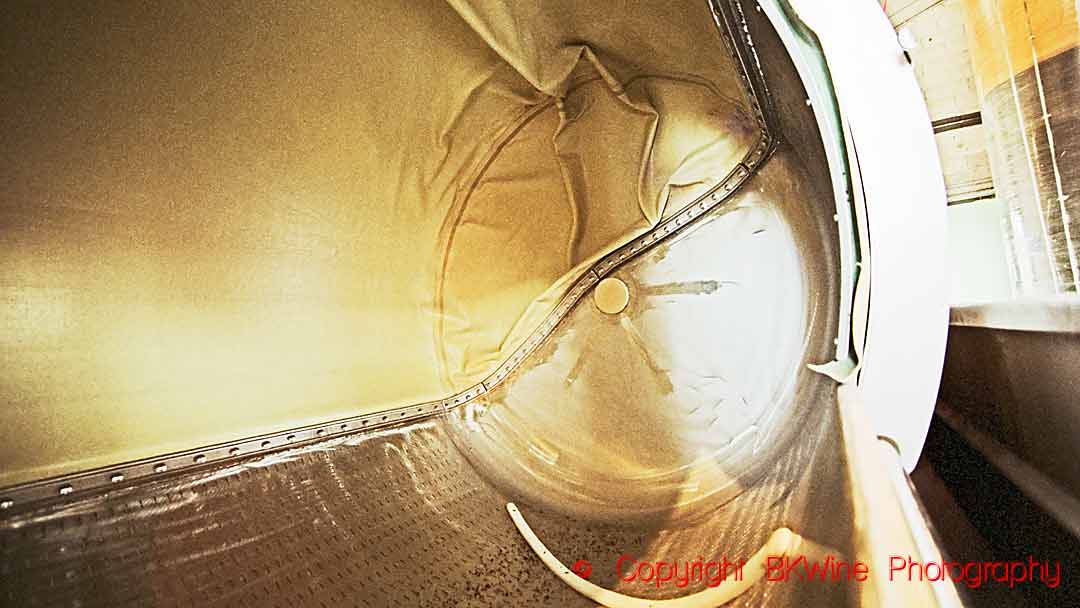
The inside of a small pneumatic wine press with the inflatable balloon on the upper left
The inside of a small pneumatic wine press with the inflatable balloon on the upper left, copyright BKWine Photography

Tearing your eyes from the color you get a scoop of dry ice and toss it into the tray. The fog that emerges casts a blanket of protective gas over the wine–it is legally wine now–preventing oxygen from breaking down the alcohol. A large electric pump moves the wine from the tray into a tank, where it will undergo a second, smaller, fermentation as the residual yeast eats any sugars released from the skins during the pressing.

You walk up to the cellarmaster as he watches the press control screen attentively, gauging how much time remains and whether to manually operate it or to allow the programming to continue. When the pressing is done, the press chamber is rotated so the door is pointing directly up, and you climb onto the machine to open the chamber door. After you get the door open, you invert the tank and the dry grapes dump into a bin. The press is terrifyingly good at its job. When you pick up a pressed grape there’s nothing in it at all. It’s devoid of all moisture, to the point of being a true raisin. When you eat one it is absolutely flavorless, with no perception of sweetness, or even bitterness, to be found.

Also in the bin are huge chunks of compacted lees and seeds, which feel like clay and can be thrown with great force. The bin of detritus and pressed berries is taken back up to the vineyard to be composted.

Grape skin, pips and lees residue after pressing
Grape skin, pips and lees residue after pressing, copyright BKWine Photography

When the press has been unloaded, and the carbon dioxide concentration has reached safe levels, the most strange task in winemaking comes up: cleaning a press.

You take off as much clothing as you are comfortable with, which is more and more as the season goes on, and climb up into the tank. It’s black in there. Black, and stuffy. The air is stale from the remaining carbon dioxide and the steel is warm from the pressing, but now you’re in it. It’s like a submarine, claustrophobic and unwelcoming. It’s all metal and kevlar in there, and the low ceiling forces you to stoop over or crouch on your haunches. You’ve been given a headlamp, Allen key, brush, and a tool for opening grates.

As you illuminate the chamber, you begin removing the bolts which hold the long juice grates in place. The grates act as sieves, stopping berries from being pushed out into the liquid catch tray. Using the tool, you force them to the side, which allows them to swing open and creates a deafening clang. Taking the small hand brush you begin to sweep out the remaining mummified grapes.

You work fast, not just because of claustrophobia but also because the longer you’re in there the more carbon dioxide you exhale, and the hotter it gets. Even though the gas is denser than air and falls out of the tank, the slight build-up makes each breath uncomfortable, and the sweat rolling down your brow and back urges you to work faster.

When the grapes have all been swept down out the door and into a waiting bin you shout out at your cellarmaster. You forget the word for hose in Spanish, so you call it a “Pinche herramienta de agua.” He laughs, knowing exactly what you mean and amused to be working alongside someone who sounds like a vulgar Mexican toddler. He hands you the hose. “¿Caliente o frío?” He asks. “Caliente, con un poquito frío,” you reply, brokenly. If it’s fully hot water you’ll steam yourself like a mussel. If it’s fully cold, the steel chamber will have you shivering in a couple of minutes. Even with the bit of cold in the hose, the chamber is still sauna-like in moments. The steam is so thick that you can’t see the other end of the tank just six feet away. If you were careful you could stay dry, but the filth of working with wine is so thorough that it’s a small blessing to have a steam shower on company time. Simply being around grapes during processing puts enough sugar in the air that when it dries with the sweat you can come away feeling like a salted caramel. Hosing out the loose seeds and lees, you give the tank one more rinse and bail out. The light hurts your eyes and the freshness of the air shocks your skin, but you come away feeling vindicated and clean.

Cleaning winery equipment, here a tank, can sometimes be acrobatic
Cleaning winery equipment, here a stainless steel fermentation tank, can sometimes be acrobatic, copyright BKWine Photography
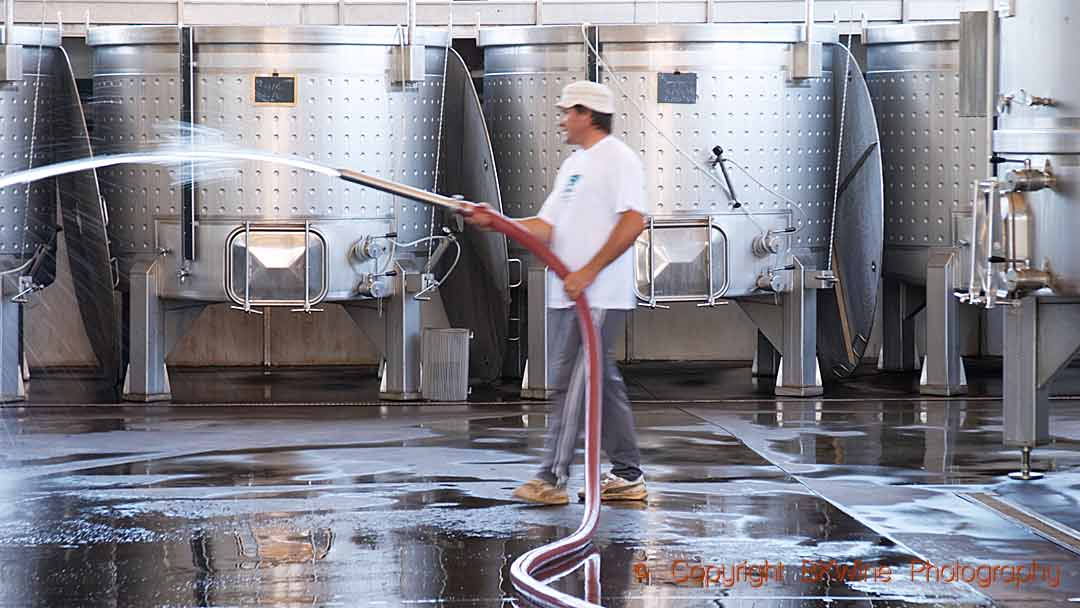
Cleaning the wine cellar and steel tanks with water
Cleaning the wine cellar and steel tanks with water, copyright BKWine Photography

You take a moment to stand in the sun to dry off while your coworkers shovel up loose grapes and clean the pumps. You’ve got about another hour in your usual shift, and you’re already well into overtime. Now dry, you fill a cloth bag with dry ice and hang it inside the tank of newly pressed wine, so that through the night the ice will gradually melt and create a steady blanket of protective gas until you can top the bag up the following morning.

Taking a moment to drink from your water bottle, you think about what stage of the season you’re in. The harvest is winding down. Mornings are colder, days and hours are shorter, and the easy part of the winemaking process is all that remains. You reflect on the strange speed of it all. About two months from start to finish. The beginning of the harvest captures your thoughts with particular clarity.

Traveling up to the vineyard in the early September heat, walking along the rows of grapes baking in the late summer sun, picking them at random to test for sugar content back at the winery. The beginning is slow. The fruit is indifferent to your schedule. It works on its own time, but when it’s content to be picked the madness creeps into every corner of the winery. Not the madness of bacchanal, but of labor desperate for time.

Tons of grapes arrive in the morning, picked before dawn, and quickly weighed before processing. Hundreds of pounds of fruit at a time are fed onto an elevator by a worker with a rake, as another beside them tries to pick out the green leaves and occasional lizard. The fruit is lifted fifteen feet in the air and deposited into the spinning belly of the destemmer, which is as much a Rube Golderberg-esque enigma as it is agricultural machinery. The fruit falls onto a rotating, perforated, cylinder, inside of which are a series of whirling batons that knock the grapes from the stems, through the holes of the cylinder, and down into the metal tank they will ferment in. The stems and leaves are simultaneously carried by a conveyor and deposited in a compost bin. The fruit is kept under dry ice, and as soon as one bin is processed another takes its place.

The inside of a destemmer with a rotating spindle with arms
The inside of a destemmer with a rotating spindle with arms, copyright BKWine Photography

The destemmer is a Gordian Knot of filth; you clean one corner of it and the sugary grime you knock away with steaming water is splashed upon another infinitely more minute and obscure crevice of the machine. The washing of a destemmer is no mean feat, and the only thing filthier than the machine is the person washing it. When ripe grapes are processed a fine mist of saccharine juice hangs in the air like a bad joke, coating the necks and arms of those nearby. Specks of leaf, dirt, and other detritus from the vineyard coat you and mix with the sweat of a ninety-degree warehouse to wash that grime into every corner of your body.

Then there is the air, which during a harvest is always full of the aromas and fumes. There’s the almost ubiquitous burn of carbon dioxide, from the dry ice and the ferments themselves. Careless workers will open a covered ferment to peek inside and be knocked backwards by a lungful of burning, hot, carbon dioxide. Your lungs feel scalded as you cough away tears.

Cleaning a destemmer with high-pressure water at a winery
Cleaning a destemmer with high-pressure water at a winery, copyright BKWine Photography

Worse still is the sulfur. Sulfur, used worldwide to kill unwanted yeast and bacteria, is horrific to breathe. It’s denser than air, but not so dense as to fall fully to the floor. When sulfur is added to a tank anywhere near you, you will develop at first a mild itch and then a caustic irritation in every nodule and lobe of your lungs. It is like breathing bleach, or rust. You’ll cough and hack but you didn’t bother to wear your respirator due to the heat and now all you can do is your job, and without vocal complaint. Throughout the day you relish any opportunity to stand in the cold room, the huge climate-controlled section of the warehouse where hundreds of thousands, if not millions, of dollars’ worth of wine rests in barrels waiting for its graduation into bottles. You suck that cold air like life floats upon it, and then it’s back to the tanks.

Adding yeast to a five-ton tank of the best Cabernet Sauvignon fruit grown in Sonoma feels like a daring accomplishment. In just a couple hours the heat coming off the ferment is titanic, as the yeast runs through the sugar like fire in the hills. The froth and foam of the yeast eating away at the grapes is terrific.

Soon the entire winery smells like a bakery, and the fabric covers that rest on top of the ferment tanks are soon pushed up and out by the amount of gas. They bulge like frozen soda cans, they’re so pressurized. It feels big, but it also inaugurates a new period of the winemaking process of anxious attention to progress.

The winemaker paces the warehouse, tasting from the vats, absorbed in his viticultural machinations, and muttering to himself about sugar concentration, muted tannins, and water content. While cellarmasters are pragmatists, winemakers can seem esoteric to the layman. If you shatter his concentration with a question about what he’s thinking, he’ll subject you to a personal treatise informed by equal parts UC Davis-cited chemistry and survivorship bias. As such, you ask regularly.

Fermentation tanks at a big winery in Rioja, Spain
Fermentation tanks at a big winery in Rioja, Spain, copyright BKWine Photography

With the ferments started, the tasks which fall to the wine peon alternate between tedium and strain. The most physically difficult job in the winery is what is called a “punch down”. Early in the fermentation process, the grapes are very buoyant and firm, meaning that they float to the surface of the tank, on top of the juice that has been released. It’s your job to make sure that the berries are mixed so that they all break down at the same rate. You’re given a huge metal tamper, sort of like a massive cocktail muddler, and told to ‘punch down’ the cap of floating grapes. It’s easier said than done.

The strength of the fruit is remarkable, and early in the season, you could almost stand on the cap. It takes all your strength to push down through the grapes, and your reward is seeing the cap break and a tide of carmine juice flood over the floating berries. You’ll do this to six tanks a day for about a month and a half.

The tedium is exemplified in a task called a pump over, in which you attach a powerful electric pump to a valve at the bottom of the tank and juice is pumped up and over to be sprayed back onto the cap of berries at the top of the tank. This cycling of juice through the fermenting fruit ensures there are no pockets of fruit uncontacted by yeast and that all parts of the tank ferment evenly. In practice, this really just amounts to standing around spraying grapes with a juice hose for twenty to forty-five minutes per tank. It’s not uncommon to spend two hours a day doing just pump overs, but in that time you’ll be able to get through plenty of audiobooks.

Pumping over, spraying the cap in the fermentation tank with must
Pumping over, spraying the cap in the fermentation tank with must, copyright BKWine Photography
Pumping over fermenting must via an open container for aeration
Pumping over fermenting must via an open container for aeration at a winery in South Africa, copyright BKWine Photography

Along with the punch downs and pump overs, you take daily samples from each ferment tank and measure something called brix, in effect the amount of unconsumed sugar within the solution. Brix in the context of winemaking is a measurement of theoretical alcohol. The goliath reds you make at this winery demand high initial brix. To get to 15% or higher alcohol by volume you need a starting brix measurement of 28.

Each day as you see that number drop and the ABV rise you can taste the progress. The sugars wane and then disappear as the juice descends into a tangled web of tannins and ethanol. Each day a new element of the wine comes forth, as you taste the wine’s development from simple fruit juice to a product that, with time and care, commands attention and accolades.

Measuring the sugar contents in the must with a hydrometer or mustimeter in a glass
Measuring the sugar contents in the must with a hydrometer or mustimeter in a glass, copyright BKWine Photography
Taking a tank sample to measure the sugar contents in the must
Taking a tank sample to measure the sugar contents in the must, copyright BKWine Photography

But before the accolades, the attention, and the indulgence, comes the frustration. The long hours, the discomfort, the heat, the filth, the last two and a half months, all to barrel the wine and watch it lay entombed for three years before it’s merely ready to be sold. Three years, for the bare minimum. It takes seven to ten years for the wine to reach its peak of flavor and complexity. You overfill a French oak barrel, distracted by aromas of toasted wood and tannic wine, thinking of the decade that will pass before the fruits of your labor are well and truly ripe.

Filling barrels with wine in a winery
Filling barrels with wine in a winery, copyright BKWine Photography

The wine is now aging in oak barrels, stacked thirty feet high, and your time here has come to an end. There’s nothing for a winery intern to do in the off-season. The labor is delicate, the changes minute, and the skills less common.

You’re given a few bottles, the fruits of different hands from years past.

As you depart in the brisk November evening for the last time, you look down at the crisp label of the most artisan of White-Collar luxuries and reflect on the labor and skill that made it. The methods look different, but the relationship between work and art remains unchanged since hand first touched vine.

Chose your language. Read the article in:

Author:

Author:

Share this post:

One Response

  1. Absolutely fascinating! What a well-written account that places the reader directly into the art and labour of winemaking. I raise a glass to this.

Leave a Reply

Your email address will not be published. Required fields are marked *

  Subscribe to comments:

Notify me of followup comments via e-mail. You can also subscribe without commenting.

SUBSCRIBE TO OUR NEWSLETTER!

25,000 subscribers get wine news every month. You too?